
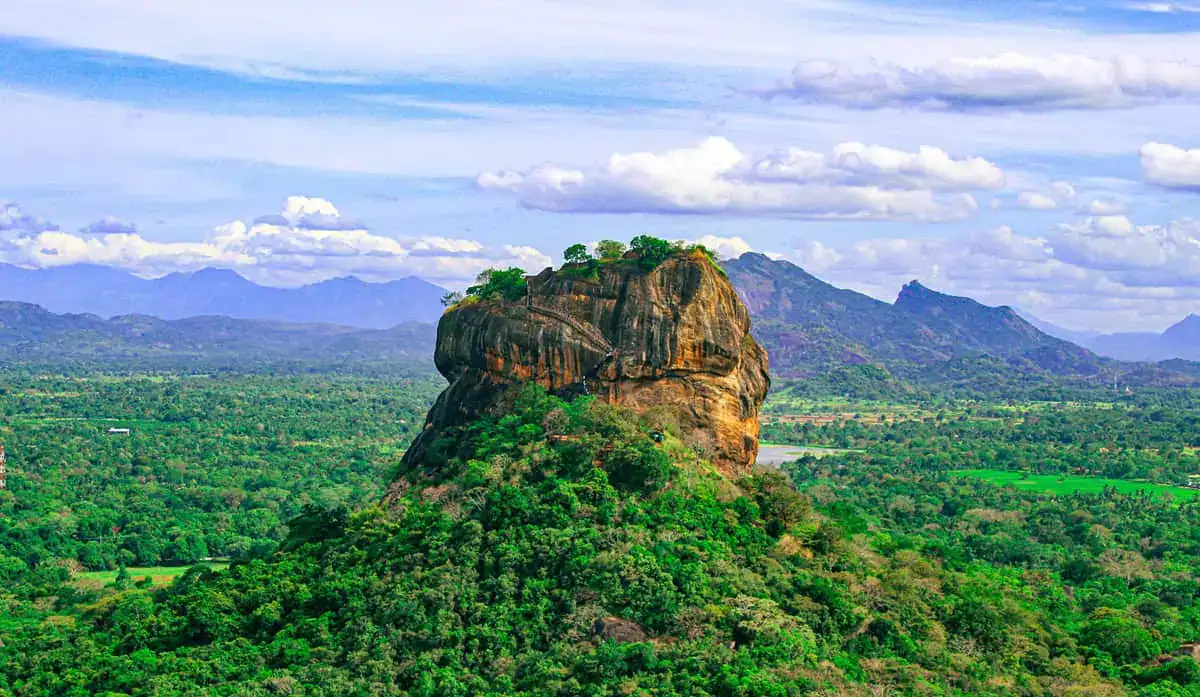

Sigiriya Rock Fortress, also known as Sigiriya Lion Rock, Sigiriya Ancient Rock, or Sinhagiri, rises from the central plains of Sri Lanka with zero effort in theatrics but all the direct force of fact. It is an essential ancient city of the Cultural Triangle of Sri Lanka.
Sigiriya sits between Habarana and Dambulla. The summit looks like a flat plateau that waits for your feet. You see a straight vertical rock column. You understand the scale instantly. Sigiriya is a climb that rewards every step. Sigiriya is not a museum piece. It’s a living archaeological field, where the ancient structures and designs still stand, and you can feel the history in your legs and breath. Few places in Asia build this physical connection between your body and a site of royal planning.
Sigiriya is one of the strongest anchor points for trips across central Sri Lanka. Photographers call it dramatic. Reality is more direct. Sigiriya looks bold and exact. Sigiriya does not hide behind context. Sigiriya stands alone. That is the appeal.
If you are interested in Sigiriya Rock Fortress, we recommend reading our “Ancient Cities and Cultural Heritage in Sri Lanka” guide.
History and Culture of Sigiriya Rock Fortress
The story of Sigiriya Rock Fortress places you in the midst of a power shift in the fifth century. King Kashyapa chose Sigiriya as his new stronghold, ruling from 477 to 495. Fearing a return strike by his brother Moggallana or Mugalan, he built a mountain palace and stronghold on a rock that was safe and easy to defend. Sigiriya, with its short reaction times for guards and clean lines of sight in every direction, was a strategic masterpiece. It was not just a palace, but also a fortress, a living testament to the historical and cultural significance of this site.
Sigiriya was not a short-lived royal block. Kashyapa ruled here for almost two decades. Every part of the site had a role. Sigiriya water gardens signalled status. Sigiriya boulder gardens guided movement. The terraced gardens in Sigiriya made the climb feel staged. At the summit, the palace used exposed rock surfaces. Sigiriya combined strategy and art.
After Kashyapa fell, Sigiriya underwent a change in use. Monarchs left. Sigiriya served as a monastery. Forest weathered the terraces. Wind and temperature shifts aged the plaster and pigments. You walk through layers of time. You do not follow an abstract timeline. You walk on stone.
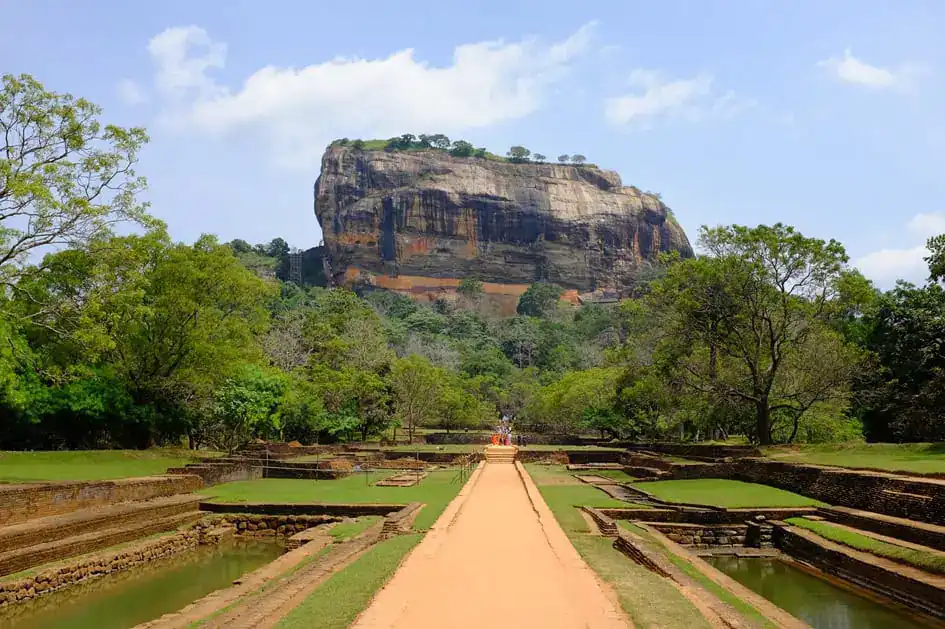
Sigiriya with the ancient garden (Photo: Wrobell, CC BY-SA 3.0)
Global Recognition and UNESCO Heritage Site Status
UNESCO declared Sigiriya Rock Fortress a World Heritage Site in 1982. UNESCO did not do this due to scenic appeal. UNESCO listed Sigiriya due to its planning and engineering. Sigiriya stands as a planned royal complex with control of water pressure and water flow in an arid region. The hydraulic systems had ponds, moats, channels, and tile-lined drops to slow the inflow during peak rain.
Sigiriya frequently appears on global travel lists, having been featured in National Geographic, BBC Travel, and numerous annual summary lists in newspapers worldwide. Sigiriya has become one of the most recognised archaeological features in South Asia. Many travellers start their first Sri Lanka route here. Sigiriya sits next to Dambulla. This cluster forms a tight two- or three-day loop for you if you prefer short transit times.
Location of Sigiriya and How to Get There
Sigiriya sits in the North Central Province. Sigiriya sits 15 kilometres from Dambulla. The Dambulla Cave Temple is situated in the same area. You can reach Sigiriya from Colombo by private car, bus, or train, followed by a bus transfer.
Rough travel times from Colombo
- Car 3.5 to 4.5 hours
- Train to Habarana, approx 4 hours plus 20-minute taxi
- Bus approx 5.5 to 6.5 hours
You travel around the Sigiriya region by tuk-tuk. Tuk-tuk drivers know each turn. Tuk-tuk cost floats by distance. Tuk-tuk access simplifies quick trips to Sigiriya Rock Fortress, Pidurangala Rock, and the Dambulla Cave Temple. You can hire a driver for the whole day. The roads have no complex junctions.
It will be easy to get there and get around Sigiriya if you read and familiarise yourself with the transport in Sri Lanka.
Weather and Climate Plus Best Time to Visit Sigiriya
Sigiriya sits in the dry zone. You deal with sharp heat from late morning—the sunrise and the first hours after it stay cooler. The second half of the afternoon feels direct yet tolerable. The months from December to April tend to be dry. May to September sees irregular rain. November can give short, intense showers.
The best time to visit Sigiriya is in the early morning hours. The best months for sky clarity are January, February, March, and early April. Sigiriya Lion Rock looks crisp when the sun hits the western side during the climb up. Carry water for this climb. You will sweat within minutes. It is normal.
It is better to read and familiarise yourself with the weather in Sri Lanka and the best time to visit before combining your visit to Sigiriya with other destinations in Sri Lanka.
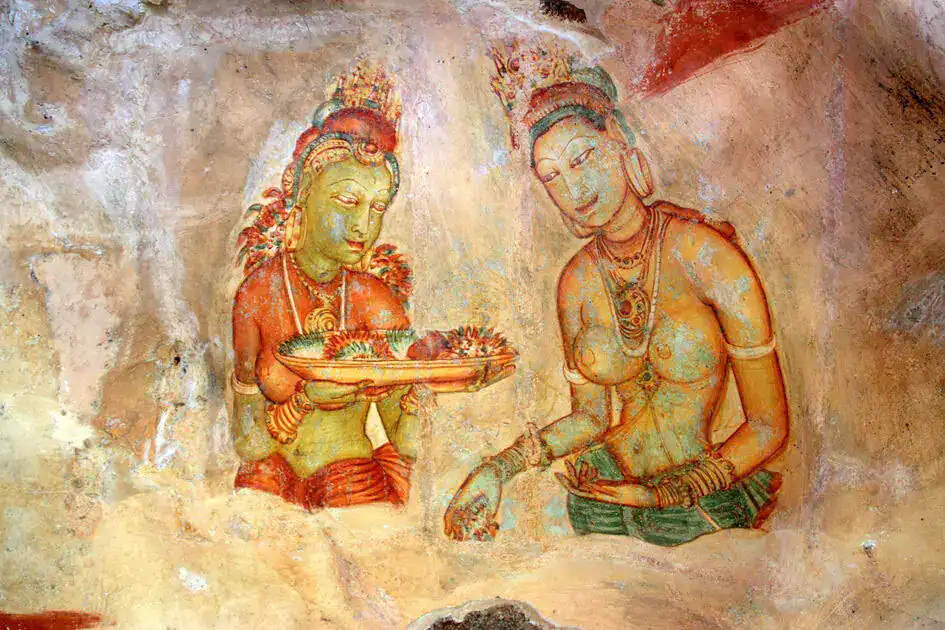
Frescoes in Sigiriya (Photo: Yves Picq, CC BY-SA 4.0)
Why Sigiriya Is Special
Sigiriya wins due to planning. You see a whole architectural plan etched into a monolith. Everything has form and logic. The layout of defensible gate sequences. The separate ramp sequence to the summit. The water gardens with pools in geometric shapes. Even the Mirror Wall once held reflections with clarity.
Sigiriya links culture, geology, engineering, and the human act of climbing. Sigiriya does not hand you the view at ground level. You earn your view with your steps. That bond creates satisfaction. It makes Sigiriya special.
Sigiriya Height Measurement and Site Plan Basics
The summit of Sigiriya stands approximately 180 metres above the surrounding plain (349 m above sea level). The base area has a site plan with moats, gardens, and guard points. The path to the top is paved with stair sequences. You see steel and rock steps. You will see some steep pitches.
Key area blocks
- Main entrance and ticket office
- Moat and outer water gardens
- Terraced gardens
- Fresco alcove
- Mirror Wall
- Lion Gate
- Summit palace ruins and rock surface platforms
The Lion Gate
Sigiriya Lion Rock derives its popular name from the Lion Gate. Two lion paws frame the staircase that rises to the summit. Visitors used to pass through a complete lion sculpture, symbolising the power and grandeur of the kingdom. Workers carved the paws into the rock. The lion head structure no longer exists. These paws give Sigiriya a direct symbol. Sigiriya Lion Rock becomes literal here.
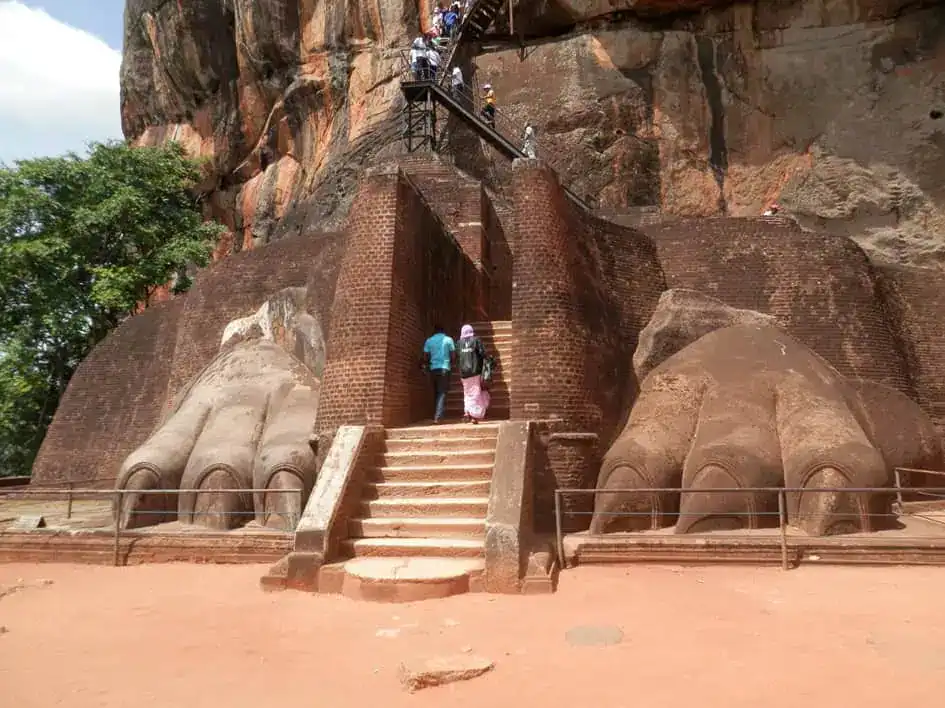
The Lion Gate (Photo: Gonzo Gooner, CC BY 3.0)
Sigiriya Frescoes
The frescoes appear on the western face. They show female figures in pigment. They once stretched across a larger area. Exposure over time removed much of the paint. The ones that remain show precise lines. These frescoes display intricate details that suggest elite patronage. You view them on a narrow passage ledge. You stand in a line. You stop for a limited time. The pigments need protection from sweat and air shifts. You follow the guard’s instructions here.
Mirror Wall
The Mirror Wall sits between the frescoes and the Lion Gate. The true polished plaster surface once held a reflective logic. Poets left verses here over a thousand years ago. This wall illustrates how people continued to engage with the site long after Kashyapa. The Mirror Wall is a testimony to visitation habits across centuries. Keep your hands away from the wall. Touch harms the surface. Guides speak of this point on every tour.
Gardens of Sigiriya Rock Fortress
Sigiriya has three garden zones.
- Water gardens
- Boulder gardens
- Terraced gardens
Water gardens used controlled water flow. You see pools in geometric layouts. Stone channels look simple yet have specific hydraulic tasks. Boulder gardens use giant stones to shape space. Terraced gardens march you upward towards the summit climb.
Entrance, Tickets, and Facilities
The entrance sits on the western side. Tickets are priced according to foreign and local bands. You buy your ticket at the office before the main moat. Ticket check happens after the first garden block. Toilet facilities sit near the base. Drinking water is not available inside the climb sequence. Buy water at the entrance zone. Keep your bottle sealed.
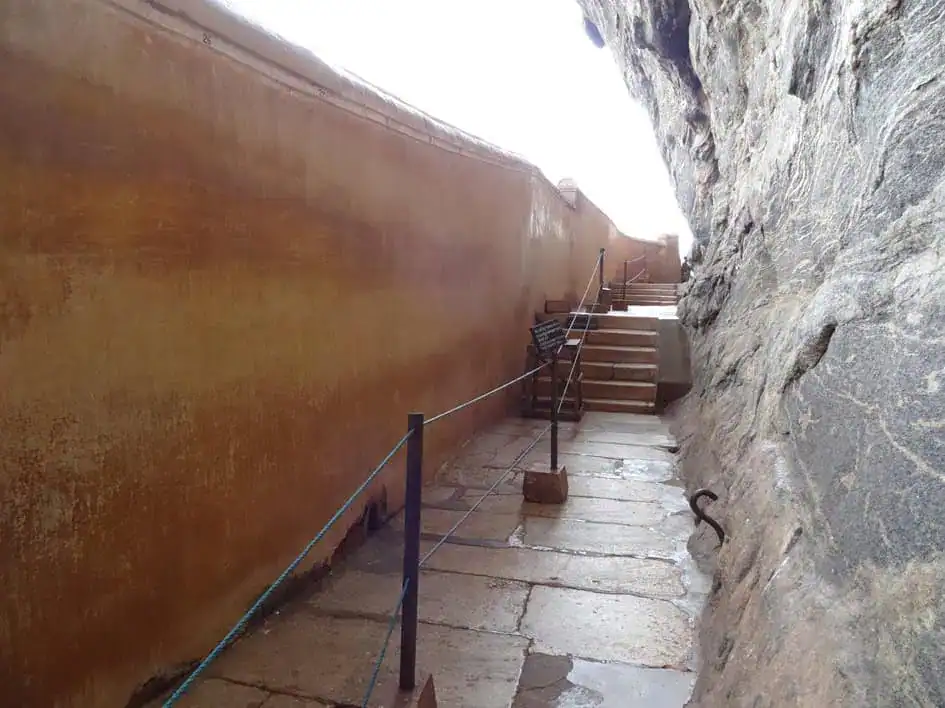
Mirror Wall – Sigiriya (Photo: Cherubino, CC BY-SA 3.0)
What You Should Bring
- A hat.
- Sunscreen.
- Your own water bottle.
- A camera.
- Light shoes with a grip.
- Cash for the entrance and tuk-tuk.
- Sunglasses.
- Tissue.
- Simple snacks.
Dos and Don’ts for Sigiriya Rock Fortress
- Do wear breathable and comfortable clothes.
- Do start early.
- Do carry water.
- Do respect height caution signs.
- Do respect guard instructions near the fresco zone.
- Take short rests in shady pockets.
- Consider combining Sigiriya with the Dambulla Cave Temple.
- Do not touch the fresco walls.
- Do not photograph the frescoes.
- Do not litter.
- Don’t feed animals.
- Do not use drones in the Sigiriya premises.
- Do not make huge noises; there are hornet nests in the Sigiriya premises. If you disturb them, they will disturb you in return.
- Do not climb or walk on the ancient ruins.
- Do not write anything on the ancient walls.
- Do not climb on unstable fragments.
- Do not bring alcohol.
Must Do Things and Do Not Miss Things
- Climb to the summit.
- See the views in each direction.
- Spend time near the Lion Gate.
- Observe the terraced gardens from a high angle.
- Track the line of the Mirror Wall.
- Take a slow pass across the water gardens.
- Walk the moat circuit at ground level.
- Pause to see how the site plan shows defensive logic.
- Pair Sigiriya with Dambulla on the same day if you have tight schedules.
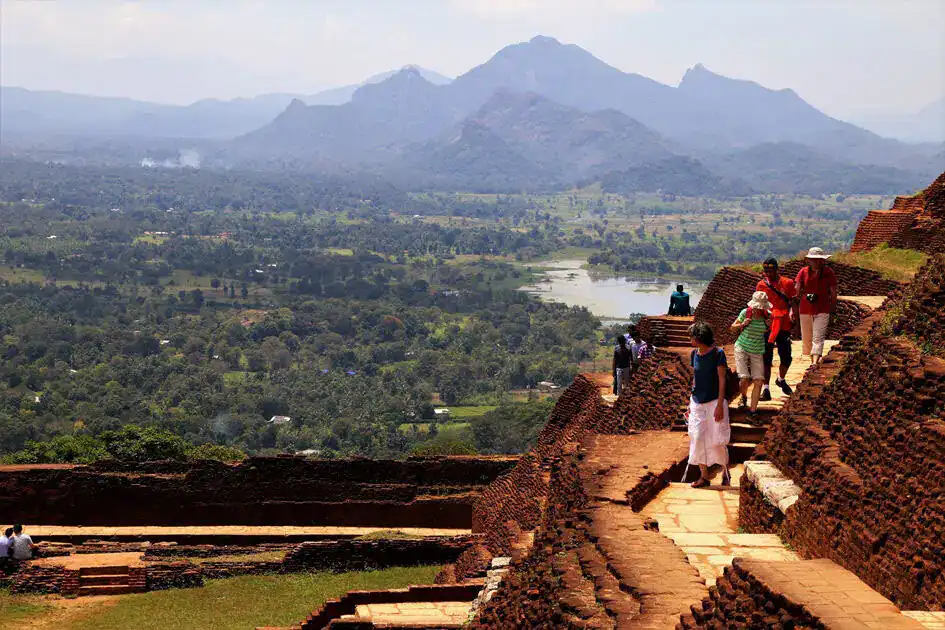
The view from Sigiriya (Photo: Julita via Pixabay)
Activities and Experiences Around Sigiriya
Sigiriya offers a climb and an archaeological visit. You build your own route. If you like photography, sunrise or early morning gives deep contrast along the edges. You can pair Sigiriya with Pidurangala Rock for a sunrise or sunset experience. Pidurangala looks straight across at Sigiriya. The path is rougher. The view of Sigiriya Lion Rock from Pidurangala is textbook.
If you are interested in hiking, trekking, and mountains, we recommend reading about Sri Lanka’s popular mountains.
Nearby Destinations and Practical Planning
Dambulla sits 15 kilometres away. The Dambulla Cave Temple features rock-cut cave temples with painted ceilings. Habarana sits close. Habarana edges into forest corridors that connect to Minneriya and Kaudulla National Parks. Minneriya National Park is home to elephant herds during the dry months. Kaudulla also holds herds. Both sit close to Sigiriya Rock Fortress.
You sequence Sigiriya on day one. The Dambulla Cave Temple works on the same day in the afternoon. Elephant safari day two. This cluster saves transit time and offers direct value.
Accommodation and Dining Near Sigiriya
Guesthouses, homestays, and boutique hotels sit around Sigiriya. Most properties offer breakfast. Dinner often requires pre-ordering if you stay in small homestays. Better restaurants sit near the main Sigiriya road junction. Dambulla has a broader range of dining options. Habarana has eco lodge dining options. Expect buffet options at larger hotels. Expect local home cooking at small stays.
Photography, Drones, and Rules
Photography is free across most of the Sigiriya Rock Fortress. Do not launch drones in the Sigiriya premises. Guards monitor drone use. Confiscation occurs when visitors violate drone rules.
Photography in the fresco area is subject to restrictions. Guards will say where flash is not allowed. Follow that. Use a small bag. Tripods slow movement in tight sections. The Mirror Wall passage is narrow. People line up behind you. Keep gear compact.
Stay on marked paths. Keep volume low. Do not feed wildlife. Buy filtered bottled water if possible. Use refill points at your hotel to reduce plastic purchases. Respect local workers. Use local guides who are trained by the Department of Archaeology. These guides protect knowledge. They also reasonably make income from cultural tourism.
For a complete overview of planning your first trip, we recommend reading the Complete Sri Lanka Travel Guide and How to Plan a Sri Lanka Trip Step by Step: Complete Travel Guide.
Souvenirs
Small stores sit near the entrance. Hand-painted postcards and small wooden carvings often appear. Buy postcards of Sigiriya in early morning light. Buy local crafts from certified sellers. Dambulla and Habarana craft stores also stock masks and lacquer items. Do not buy artefacts with suspicious origins. Legal sellers work exclusively with modern crafts.
Sigiriya is a site you feel in physical steps. Sigiriya rewards your early start. Sigiriya lifts you above the flat plains. Sigiriya illustrates a pivotal moment when power was harnessed to build a rock palace in response to political fear. The gardens, frescoes, Mirror Wall, Lion Gate, and terraced steps tell a direct story. You leave with a memory of stone, water, and sweat.
You combine Sigiriya Lion Rock with Dambulla. You walk to the Dambulla Cave Temple for a direct link to Buddhist art. You sleep in Habarana or Dambulla to keep logistics tight. You respect the site. You support local guides. Sigiriya Rock Fortress will stay in your memory due to the climb, the view, and the logic of royal ambition carved into a column of stone.
The official Website – Sigiriya
(Featured image: Chamixth, CC BY-SA 4.0)

I am a Sri Lankan medical doctor who spends my free time travelling, exploring new destinations, and documenting the beauty of the island I call home. I have journeyed across almost every corner of Sri Lanka with my wife and daughter — from wildlife parks and misty mountains to ancient cities, deep forests, rugged landscapes, and quiet beaches.
Travel is not just a hobby for me — it’s a way of life. I love nature, enjoy road trips, and find joy in wildlife photography. I also read widely about tourism, travel trends, and destination culture. Through my writing, I aim to help travellers experience Sri Lanka through real stories, meaningful insights, and honest recommendations — the same way I explore it with my own family.