

Introduction
Sit down to breakfast at a Sri Lankan guesthouse, or order rice and curry at a small local eatery, and there’s a good chance a little heap of orange-red grated coconut will be somewhere on the table. That’s pol sambol. For many visitors, it’s one of the first parts of Sri Lankan food they learn to recognise on sight, and one of the ones they keep reaching for.
It looks modest. Fresh coconut, chilli, onion, lime, and salt usually form the base, mixed into something loose, moist, and bright. On the plate, though, it does a lot. It brings heat, sharpness, and texture to milder foods like plain rice, string hoppers, or a slice of bread.
If you’re planning a trip, you probably want to know a few practical things. What exactly is it? How spicy will it be? Does it contain fish? How do you eat it? This guide covers those questions, along with some context on why such a simple preparation turns up at so many Sri Lankan tables.
Pol Sambol: What You Need to Know
Pol is the Sinhala word for coconut, so “Coconut Sambol” is a fairly literal English name. You may see either name on menus. In Sri Lankan cooking, a sambol is a relish or accompaniment, eaten in small amounts alongside other dishes. Pol sambol is one of these. It isn’t a main course, and you wouldn’t normally eat a bowl of it on its own.
Most versions start with freshly grated coconut, red chilli, finely chopped red onion or shallot, lime juice and salt. Many cooks also add Maldive fish, a dried and cured tuna that’s crushed into small flakes. So don’t assume pol sambol is vegetarian unless you’ve checked.
Spice levels vary a lot. Some versions are only gently warm, while others are properly hot. The colour gives you a rough clue, but it isn’t a reliable measure of heat.
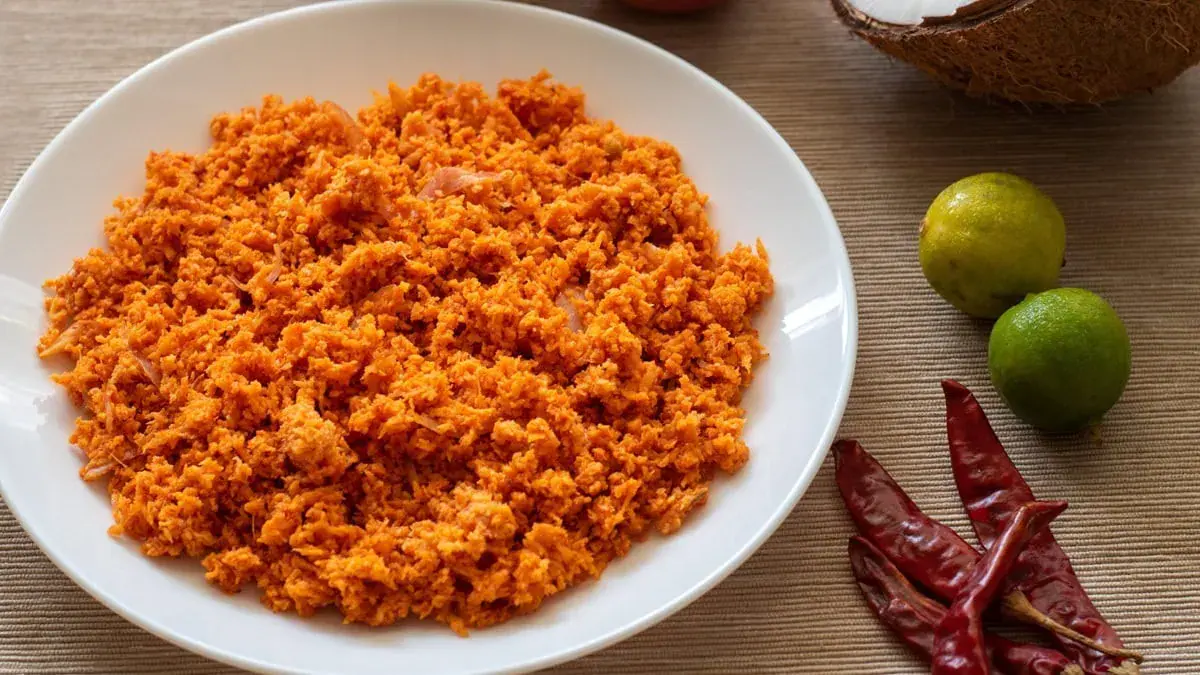
To spot it, look for loose, slightly moist grated coconut. It’s usually pale orange to deep red, with visible flecks of chilli and bits of onion, and it’s served as a small mound or in a little bowl. It isn’t a smooth paste or a cooked curry. That sets it apart from two other common accompaniments: lunu miris, a fiery red onion and chilli paste often eaten with milk rice (kiribath), and seeni sambol, a dark, sweet, slow-cooked onion relish.
Why It Stands Out
The appeal lies in contrast. Freshly grated coconut is soft, slightly sweet and gently chewy, with a richness that comes from its natural oil. Chilli adds heat, lime cuts through with sharp acidity, and salt pulls the flavours together. Raw onion gives a mild bite. Where Maldive fish is used, it adds a deep savoury note that’s hard to place if you’ve never tasted it.
Texture matters as much as flavour. Many Sri Lankan staples are soft and fairly plain, such as steamed rice, string hoppers, and bread. A spoonful of pol sambol gives them moisture, grip, and a burst of seasoning without drowning them the way a gravy would.
It’s also versatile. The same relish can turn up at breakfast, lunch, or a simple evening meal, and it works with a wide range of starches. Because grated coconut doesn’t keep well, many cooks make it shortly before serving. That’s part of why a good version tastes so fresh.
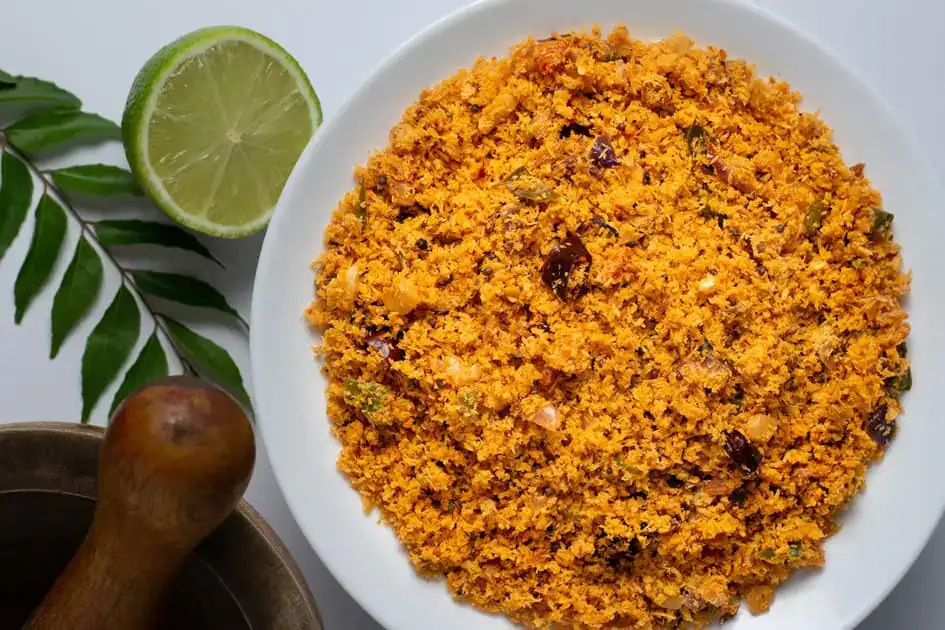
Pol Sambol (Photo: Kavinda F from Pixabay)
Where It Sits in Sri Lankan Society
Coconut runs through Sri Lankan cuisine. Coconut milk enriches curries, grated coconut goes into leafy mallums and sambols, and coconut oil is a common cooking fat. Palms grow across much of the island, especially in the area often called the “coconut triangle” around Kurunegala, Puttalam, and Gampaha.
Pol sambol is above all a home food. It needs no cooking and uses ingredients many households keep on hand, so it’s a quick way to make a simple meal feel complete. Plenty of people treat bread or rice with pol sambol as an easy, satisfying meal when there’s little time to cook.
Preferences are personal. Ask a few Sri Lankans how they like it, and you’ll probably hear different views on heat, sourness, and whether Maldive fish belongs in it. No single version speaks for every family or community.
In a typical rice and curry spread, sambols sit alongside the curries as accents rather than centrepieces. They add sharpness, heat, or freshness wherever you want them. For visitors, this often shows up as hospitality: guesthouses and homestays that serve a Sri Lankan breakfast frequently put a bowl of pol sambol out with the hoppers or string hoppers.
Popular Varieties and Regional Differences
There isn’t a fixed list of named pol sambol varieties. The differences you’ll come across are mostly between kitchens and households rather than between regions.
The biggest divide is Maldive fish. Some cooks consider it essential for depth, while others leave it out, either from personal taste or because they’re cooking for vegetarians. Both versions are common, and they can look almost identical on the plate.
Chilli is the next variable. Many cooks use dried red chilli, either ground into powder or crushed into flakes, which gives the familiar orange-red colour. Others use fresh green chilli, which makes a paler version with a greener, sharper heat. The amount ranges from a gentle hint to something that will make most first-timers reach for water.
The balance of lime and salt also shifts from cook to cook, as does the coarseness of the onion. Some cooks add a few extras, such as chopped tomato, a little black pepper or a pinch of sugar. None of these is standard, but you may meet them.
Some writers suggest that tastes differ between parts of the island. However, there’s little reliable documentation of distinct regional versions, so it’s more accurate to say that pol sambol changes with the person making it than with the map. Expect variety wherever you travel, and you won’t be disappointed.
What Is Inside
The core ingredients each do a clear job:
- Fresh grated coconut is the body of the dish. It provides bulk, mild sweetness, moisture, and richness.
- Chilli brings heat and most of the colour.
- Red onion or shallot adds sharpness and a little crunch.
- Lime juice adds acidity that lifts the coconut’s richness.
- Salt sharpens every other flavour.
Maldive fish is a common addition, but not universal. It’s tuna that has been boiled, smoked, and sun-dried until rock hard, then shaved or crushed. It adds savoury, slightly smoky depth. Less common extras include tomato, pepper, and sugar.
A few dietary points matter here. Maldive fish is a fish product, so anyone with a fish allergy, and anyone vegetarian or vegan, should ask before eating. Coconut is the main ingredient, so people with a coconut allergy should avoid the dish entirely. Kitchens often use the same grinding stone, mortar, or blender for several preparations, so cross-contact is possible even in a fish-free version. If your dietary needs are strict, ask the person who made it, and treat any answer as their best understanding rather than a guarantee.
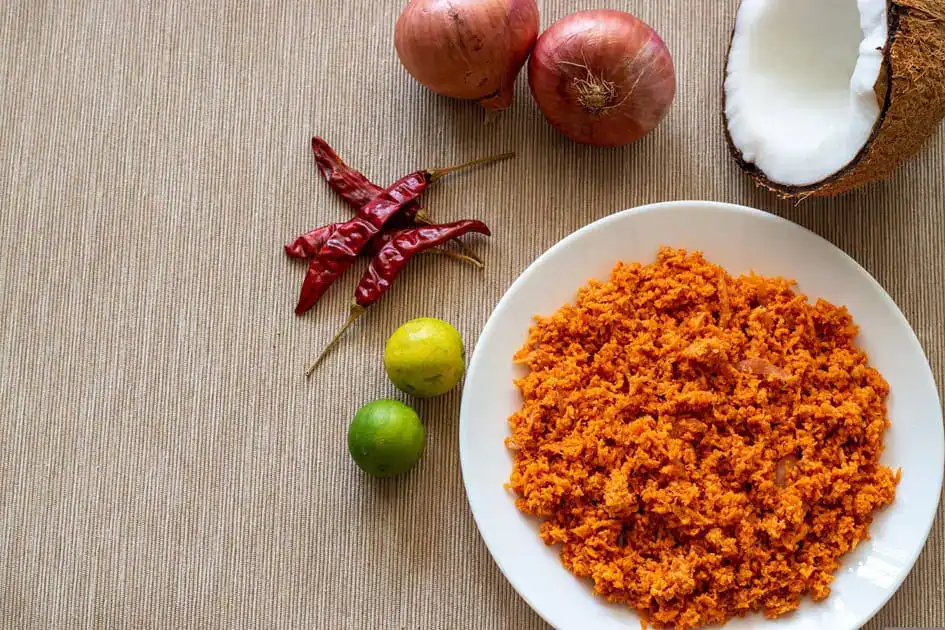
Pol Sambol and Ingredients (Photo: Kavinda F from Pixabay)
How Pol Sambol Is Made
Preparation starts with the coconut. In many Sri Lankan homes, mature coconuts are split, and the flesh is scraped out with a traditional seated scraper called a hiramanaya, a stool fitted with a serrated metal blade. Electric graters and ready-grated or frozen coconut are now common too. Cooks outside Sri Lanka sometimes use rehydrated desiccated coconut, although the texture is drier.
Next come the flavourings. Chilli, salt, onion, and Maldive fish (if used) are crushed together. Traditionally, this was done on a flat grinding stone (miris gala) or in a mortar. Today, many households use a blender or chop everything finely.
The grated coconut is then added, and the mixture is worked by hand or pounded briefly. Squeezing and rubbing the coconut with the chilli paste spreads the colour evenly and releases some of the coconut’s oil, which helps the flavours cling. Lime juice usually goes in near the end, and the cook tastes and adjusts the salt, lime and heat before serving.
The whole process is quick and needs no cooking, which helps explain why pol sambol is such a common everyday standby.
Serving Style
Pol sambol is served in small amounts. At a rice and curry meal, you’ll usually see a spoonful or two on your plate or a small shared bowl among the curries. At breakfast, it often sits in a bowl beside a stack of string hoppers or hoppers, or with bread.
As a fresh, uncooked relish, it’s usually served at room temperature. Still, a version kept in a hotel fridge may arrive cooler. Neither is wrong.
Diners don’t eat it on its own. They take a little at a time and mix it with whatever else is on the plate, so each mouthful gets some heat and acidity. Many Sri Lankans eat with the fingers of the right hand, using them to blend sambol, rice and curry. Visitors are welcome to do the same or to use a spoon and fork, which most tourist-facing places provide without question.
How to Spot a Great Version of Pol Sambol
There’s no official standard, and personal taste plays a big part. Still, a few signs tend to point to a version made with care.
Freshness comes first. Good pol sambol looks moist and slightly glossy, with the coconut still in fine, separate strands rather than clumped, dry, or soggy. The chilli colour should be fairly even through the coconut, which shows it has been properly mixed rather than just sprinkled on top.
On the palate, look for balance. You should taste the coconut, the heat, the lime, and the salt, with none of them completely drowning the others. Onion should taste fresh and sharp. If Maldive fish is included, it should add depth in the background rather than a strong fishy hit.
Remember that colour and heat are choices, not quality marks. A pale green-chilli version can be excellent, and a deep red one can be quite mild. Appearance alone also can’t tell you how long something has been sitting out. If a dish smells sour or doesn’t seem right, skip it.
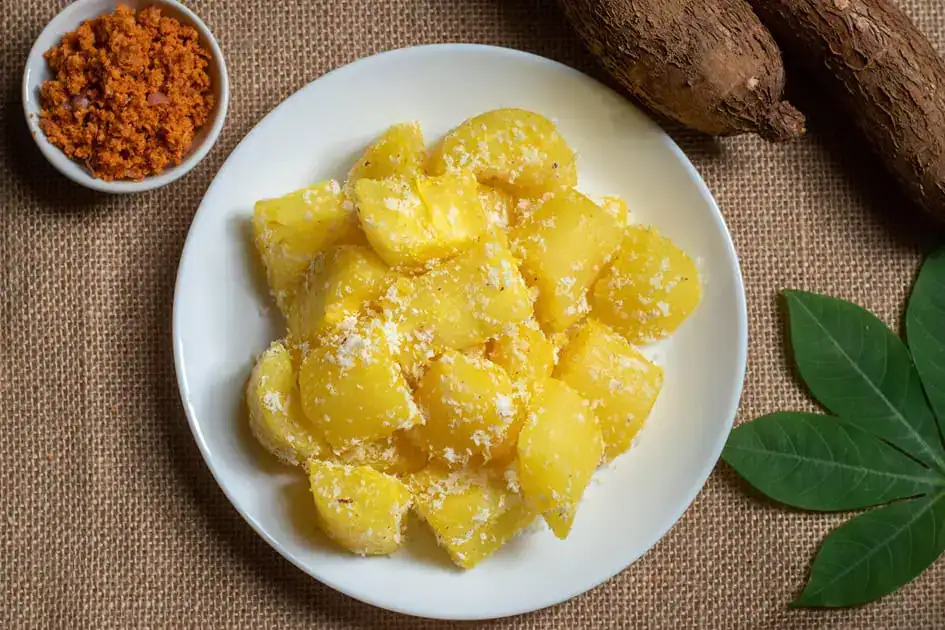
Boiled Cassava (Manioc) with Pol Sambol (Photo: Kavinda F from Pixabay)
Ordering Advice
On menus, look for “pol sambol”, “coconut sambol” or occasionally “coconut sambal”. It often isn’t listed separately at all. It may simply come as part of a rice and curry plate or a string hopper breakfast, so it’s worth asking what accompaniments are included.
Two questions are useful. First, ask whether it’s spicy and how spicy. Second, ask whether it contains Maldive fish. Staff in tourist areas usually understand the English term, and the Sinhala word umbalakada can help elsewhere. Simple, friendly questions work best, such as “Is the pol sambol very spicy?” or “Does this have Maldive fish?”
If you’d like it milder, you can politely ask whether a less spicy version or a smaller portion is possible. Guesthouses, homestays and hotels that make food to order may be happy to adjust. Busy local eateries usually make one batch for the day, so changes may not be possible there. In that case, ask for it on the side so you can control how much you eat.
How to Taste the Best of Pol Sambol
Start with a very small amount on its own. This tells you how hot this particular version is and lets you notice the separate flavours: sweet coconut, sharp lime, the bite of onion, and the slow build of chilli.
Then try it the way it’s meant to be eaten, mixed with something plain. Take a little with a pinch of rice or a piece of string hopper, and notice how the relish seasons the starch and the starch softens the heat. After that, try it alongside a curry, where its freshness cuts through richer gravies.
Adjust as you go. If it’s too hot, use less and add more rice or bread rather than reaching straight for water. A sip of water spreads the heat more than it calms it, while plain starch or something milky, such as a coconut-milk gravy, usually helps more.
Best Pairings
Some pairings are so common that you’ll meet them again and again:
- String hoppers (indiappa), steamed nests of rice-flour noodles, often served with a mild coconut-milk gravy (kiri hodi) and pol sambol.
- Hoppers (appa), bowl-shaped, crisp-edged rice-flour pancakes.
- Pol roti, a flat coconut roti that pairs naturally with a coconut relish.
- Bread, a quick, everyday combination.
- Rice and curry, where pol sambol sits among the curries as one of several accompaniments.
Beyond these, you might find it with boiled manioc (cassava) or alongside milk rice (kiribath). However, lunu miris is the more usual partner there. There are no strict rules, so if a combination works for you, it works.
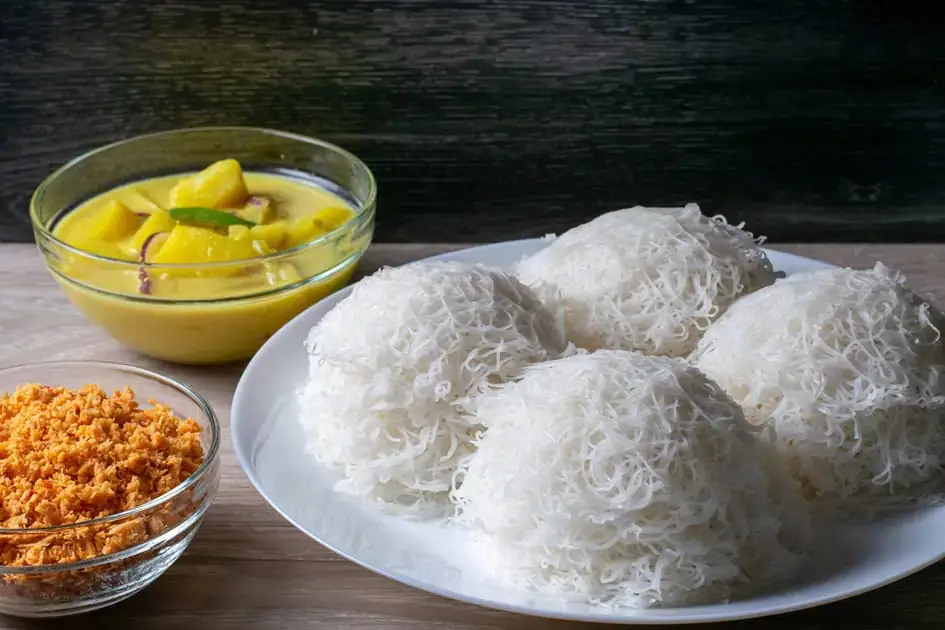
String Hoppers with Potato Curry and Pol Sambol (Photo: Kavinda F from Pixabay)
When and Where to Eat
Breakfast is often the easiest time to meet pol sambol, especially with string hoppers, hoppers, or roti. It’s just as much at home at lunch with rice and curry, and hoppers and string hoppers also turn up as evening food in many places.
Hotels that offer a Sri Lankan breakfast option frequently include it, though some resort buffets lean towards Western dishes, so ask if you don’t see it. Family-run guesthouses and homestays are often the best places to try a home-style version, since many cook Sri Lankan breakfasts for their guests.
Small local restaurants, many of which call themselves “hotels” in Sri Lanka, often include it with rice and curry or breakfast plates. Cooking classes in popular tourist areas sometimes include pol sambol among the dishes they teach, which is a good way to see the method and adjust the heat yourself. Availability varies with the kitchen and the day, so treat it as likely rather than guaranteed.
Energy and Nutrition Facts
There’s no single calorie figure for pol sambol, because no two recipes or portions are the same. The amount of coconut, the size of the spoonful, and any extras all change the numbers.
Coconut supplies most of the energy. According to USDA food-composition data, raw coconut meat contains roughly 350 kcal per 100 g, mostly from fat, and a large share of that fat is saturated. It also provides some dietary fibre. Onion, chilli, and lime add flavour but very little energy. Maldive fish contributes a small amount of protein and salt.
This is general information about coconut, not a measurement of any particular pol sambol. In practice, the relish is usually eaten a spoonful or two at a time. Hence, its contribution depends mostly on how much you take. It’s best seen as a flavourful part of a balanced meal rather than a health food or something to avoid. If you have a specific dietary condition, follow the advice of your own doctor or dietitian.
Special Tips
- Build up your heat tolerance gradually. If you’re new to chilli, try pol sambol early in your trip with plenty of rice or bread, and increase the amount as you get used to it.
- Confirm dietary details every time. A fish-free version at one guesthouse says nothing about the next. Ask wherever you eat, especially if you’re vegetarian, vegan, or have allergies.
- Pair it with gentler foods first. String hoppers with a coconut-milk gravy make an easy introduction, since the mild base softens the heat.
- Favour freshly made batches. Pol sambol is made from fresh coconut and isn’t cooked, so it’s best eaten soon after preparation. Busy places with a steady turnover, or kitchens that make it to order, are a sensible choice.
- Keep your questions friendly. Asking about ingredients and spice levels is normal and generally welcomed. A smile and a short, clear question go a long way.
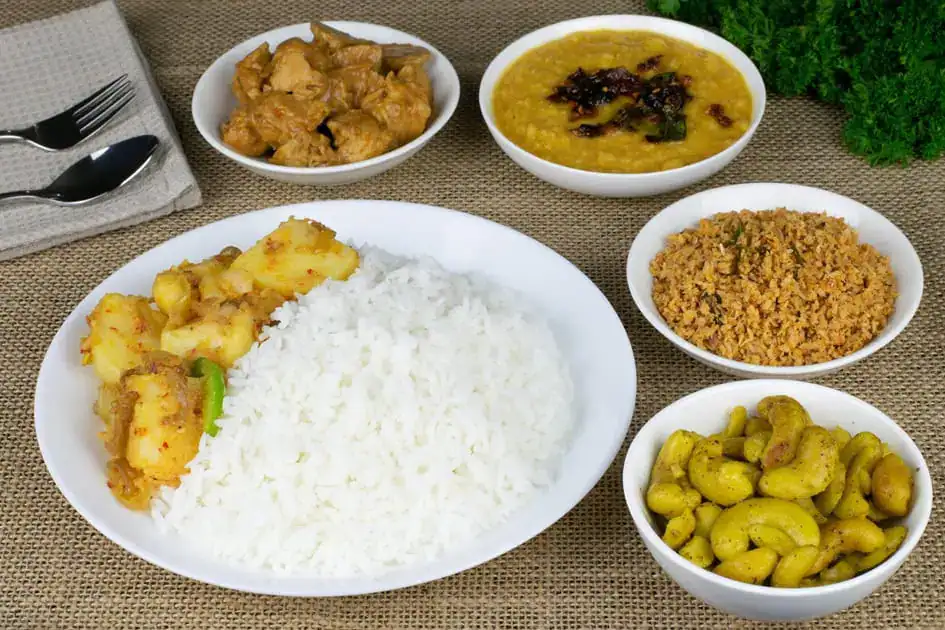
Rice and curries with Pol Sambol (Photo: Kavinda F from Pixabay)
Dos and Don’ts
Do:
- Taste a small amount before mixing it in.
- Eat it with rice, bread, roti, or hoppers rather than on its own.
- Try more than one version during your trip.
- Use your right hand if you’d like to eat in the local style.
Don’t:
- Judge spice level by colour alone.
- Assume it’s vegetarian or vegan.
- Pile your plate high before you know how hot it is.
- Expect every kitchen to change the recipe on request.
Why You Should Taste Pol Sambol
Pol sambol offers a direct look at how Sri Lankan cuisine works. Coconut, chilli, and lime are basic building blocks of the island’s cooking, and here you taste them almost undisguised. Once you know that combination, you’ll start to recognise it in curries, mallums, and other dishes throughout your trip.
It also connects you with everyday life rather than special-occasion food. This is what many families eat with bread on a busy morning or put beside the rice at lunch. Trying it at a homestay breakfast or a small local eatery shows you how people actually eat, not just what’s served to visitors.
It’s also an easy entry point. No complicated etiquette; it’s widely available, and a little goes a long way. For travellers who are cautious about spice or unfamiliar ingredients, it’s a manageable first step into Sri Lankan food.
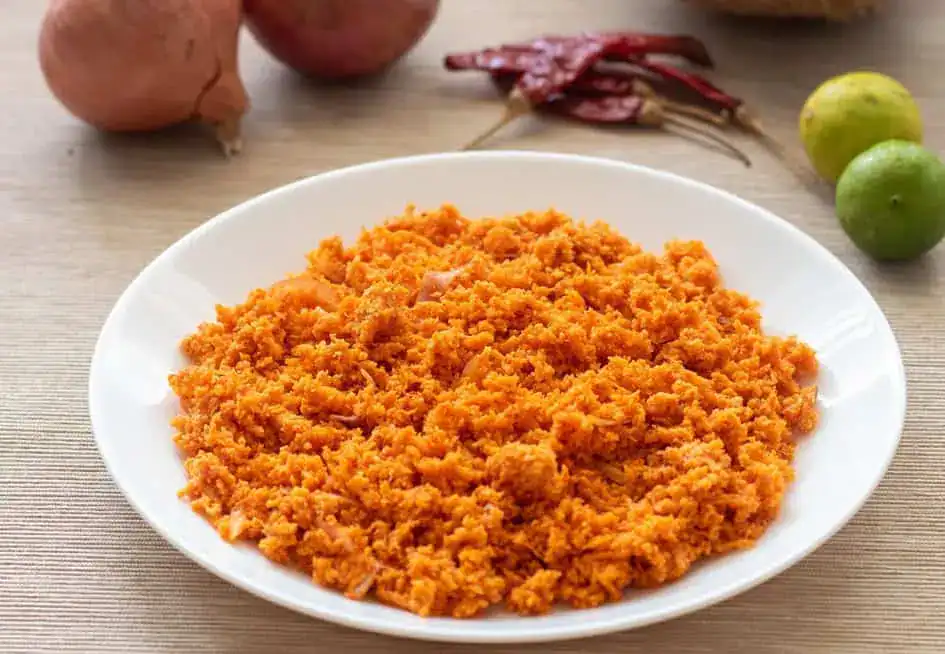
A plate of Coconut Sambol (Photo: Kavinda F from Pixabay)
Final Thoughts
Pol Sambol rarely takes centre stage, but it’s often the part of the meal people remember. Expect a fresh, coconut-based relish that changes from kitchen to kitchen: sometimes gentle, sometimes fiery, sometimes with Maldive fish and sometimes without.
Ask a couple of simple questions, start with a small taste and let it season the food around it. Whether you meet it beside a stack of string hoppers at breakfast or tucked among the curries at lunch, it’s well worth making space for on your plate while you travel around Sri Lanka.
Sources and References:
- Sri Lanka Tourism – Culinary Tourism: So Rich in Flavours. Official introduction to Sri Lankan cuisine, including traditional sambols, rice and curry, hoppers, string hoppers, roti, and the country’s diverse culinary traditions.
- Sri Lanka Tourism – Traditional Sri Lankan Food: Food Range. Official culinary reference describing Coconut Sambol (Pol Sambola), its traditional ingredients, optional Maldive fish, and common accompaniments, including rice, string hoppers, and bread.
- Sri Lanka Tourism – Wellness Tourism: Sri Lankan Cuisine. Overview of Sri Lanka’s culinary identity, coconut-based foods, local ingredients, and traditional dishes, including Pol Sambol and Pol Roti.
- United States Department of Agriculture (USDA) – FoodData Central. Authoritative food-composition database used for nutritional information about raw coconut, including energy, fat, saturated fat, dietary fibre, and other nutrients. Reference food: Nuts, coconut meat, raw (FDC ID: 170169).
- World Health Organization (WHO) – Five Keys to Safer Food. International food-safety guidance covering hygiene, safe food preparation, prevention of cross-contamination, temperature control, and the handling of fresh ingredients. Relevant to the article’s advice on choosing freshly prepared Pol Sambol.
- Centers for Disease Control and Prevention (CDC) – Food and Water Precautions for Travelers, Yellow Book 2026. Evidence-based guidance for international travellers on food hygiene, uncooked ingredients, refrigeration, and reducing foodborne illness risks while travelling.
Featured image: A plate of Pol Sambol (Photo: Kavinda F from Pixabay)

I am a Sri Lankan medical doctor who spends my free time travelling, exploring new destinations, and documenting the beauty of the island I call home. I have journeyed across almost every corner of Sri Lanka with my wife and daughter — from wildlife parks and misty mountains to ancient cities, deep forests, rugged landscapes, and quiet beaches.
Travel is not just a hobby for me — it’s a way of life. I love nature, enjoy road trips, and find joy in wildlife photography. I also read widely about tourism, travel trends, and destination culture. Through my writing, I aim to help travellers experience Sri Lanka through real stories, meaningful insights, and honest recommendations — the same way I explore it with my own family.