
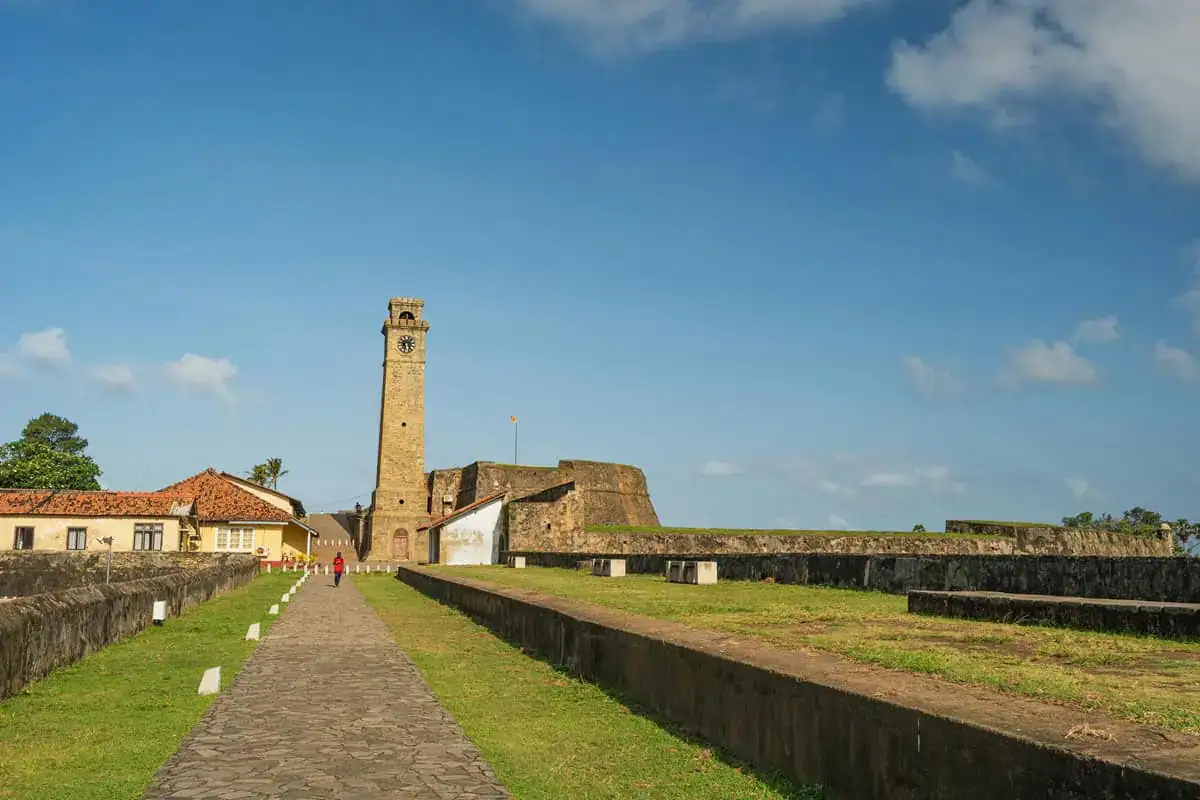

You arrive at Galle Fort with salt in the air and sun on stone. The first steps feel simple. You pass walls, gates, and old streets. Then the place starts to work on you. Sea wind pushes through narrow lanes. Bells ring from Church Street. A call to prayer rises near the harbour edge. You start to notice details. A carved lintel above a door. A date scratched into plaster. A cannon line aimed at open water. Galle Fort holds stories in plain sight. Your walk brings those stories forward.
This guide gives you a complete route, clear timing, and practical choices. You will learn what to see, what to skip, and how to plan your day. You will also learn why this small walled town matters on a global scale. UNESCO lists the Old Town of Galle and its fortifications as an “outstanding example” of an urban ensemble that demonstrates the interaction of European architecture and South Asian traditions from the sixteenth to the nineteenth centuries. Builders used European models and adapted them to local geology and climate, with coral and granite used throughout the ramparts.
Why Galle Fort Is Special
Galle Fort works as a living town, not a sealed exhibit. Residents live behind the same walls that once guarded spice warehouses and naval stores. You will see school uniforms, delivery scooters, wedding groups, and shop owners sweeping front steps. This mix creates the fort’s main appeal for foreign travellers. A walk here offers a glimpse of history and daily life.
Three features shape the experience.
First, the fort sits on a peninsula with the ocean on three sides. The ramparts keep the sea close for most of your walk.
Second, the layout stays legible. Straight streets form a grid, so you rarely feel lost.
Third, the architecture shows a layered rule. Portuguese foundations, Dutch fortification work, and British civic additions share the same blocks. UNESCO highlights this interaction as a key factor in granting World Heritage status.
History: A Port That Pulled Empires
Trade shaped Galle long before European powers arrived. Indian Ocean routes connected ports across Asia, Africa, and the Middle East. Galle sat on those routes as a safe harbour on Sri Lanka’s Southwest Coast.
Portuguese forces arrived in the early sixteenth century and began building defences. Sources commonly describe a first fortified structure from the late sixteenth century, followed by major Dutch rebuilding across the seventeenth century. The Dutch surrounded the peninsula with stronger walls of coral and granite, adding a chain of bastions to create overlapping fields of fire.
British rule followed at the end of the eighteenth century. British administration kept the Dutch street plan and expanded civic infrastructure. You still see that layer in Anglican architecture and public buildings inside the walls.
Modern Galle shifted its commercial focus to Colombo, reducing pressure for redevelopment within the fort. That slower pace helped preservation. Galle Fort also withstood the 2004 Indian Ocean tsunami better than many low-lying coastal areas, due to elevation and walls, with damage and restoration centred outside the fort core.
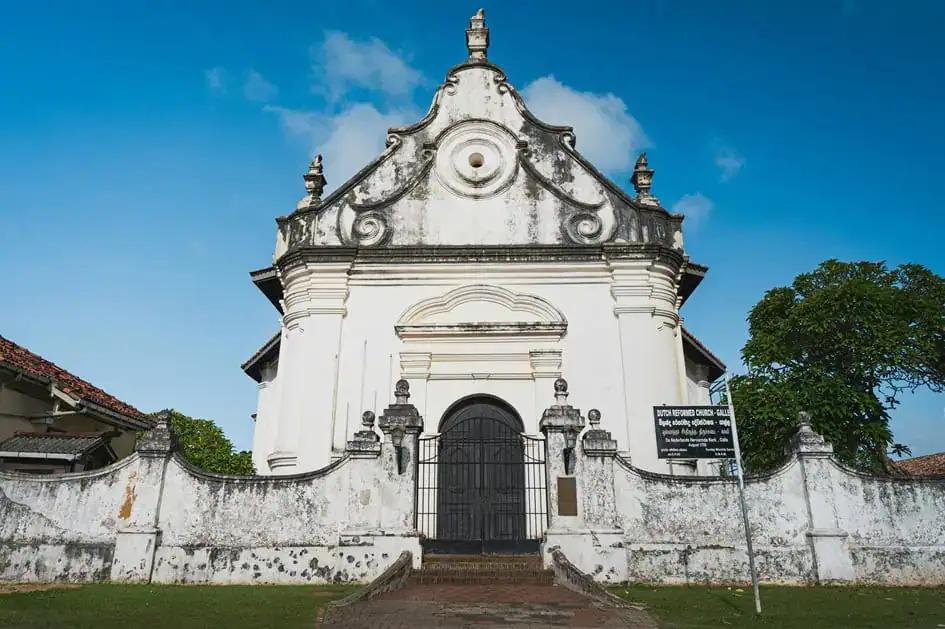
The Dutch Reformed Church – Galle (Photo: Thilina Alagiyawanna, via Pexels)
Gates: How to Enter and Why Entry Matters
Most visitors enter through the Main Gate on the north side. The Main Gate, opened in the late nineteenth century during British rule, is located between Moon Bastion and Sun Bastion. You will feel the shift as soon as you pass through. Traffic noise drops. Shade increases. Street width tightens.
A second historic entry, often called the Old Gate, dates to the Dutch period and once used a drawbridge and ditch for defence. The Old Gate connects you closer to the harbour side and trade history. Use this gate if you arrive from Galle town and want an immediate sense of the old port edge.
Layout: How to Read Galle Fort in Ten Minutes
Galle Fort sits inside a ring of ramparts with bastions spaced along the edge. Streets inside form a grid with a few curves near the walls.
Use these anchors.
- Clock Tower area: A clear meeting point near the Main Gate and Moon Bastion.
- Church Street: A landmark-heavy street with churches, the library, the post office, and historic buildings.
- Pedlar Street: A shopping and café street.
- Rampart Street: A long street near the western wall, linked to sunset viewpoints.
- Lighthouse zone: The southern end near Point Utrecht Bastion and the lighthouse.
Once you learn these anchors, you can move without maps. You also gain control over time. You choose long rampart sections when the light looks best. You cut inland when the heat rises.
Best Time to Visit and Why
Season and time of day both shape the walk.
For weather, Sri Lanka’s Southwest Coast tends to feel drier from December to April. Many travellers plan beach time on the South Coast during this period for calmer sea conditions. During monsoon months, seas grow rougher, and sunsets become dramatic, yet rain interrupts long walks.
For timing, use these patterns.
Early morning: Cooler air, fewer tour groups, soft light on stone. You will see residents opening shutters and sweeping doorways.
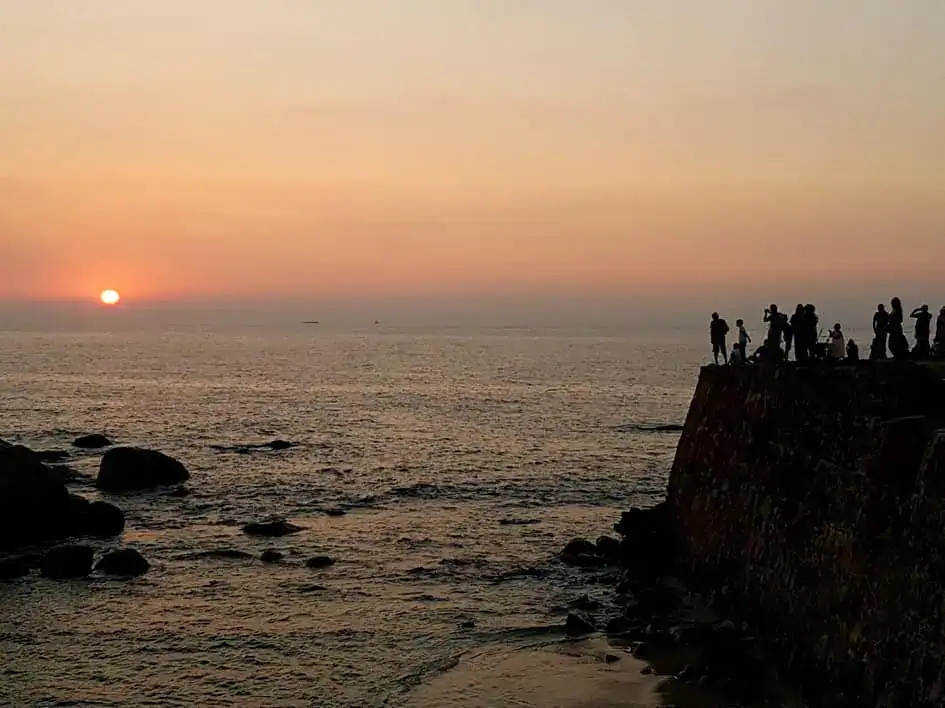
Late afternoon: The fort turns social. Locals gather on the ramparts. Travellers line up for lighthouse photos. Sunset crowds peak at Flagrock Bastion and the western walls.
Midday: Heat rises. Use museums, churches, and shaded cafés. Plan a rampart walk for early or late hours.
We recommend reading about the weather in Sri Lanka and the best time to visit.
Current Weather & Forecast in Galle
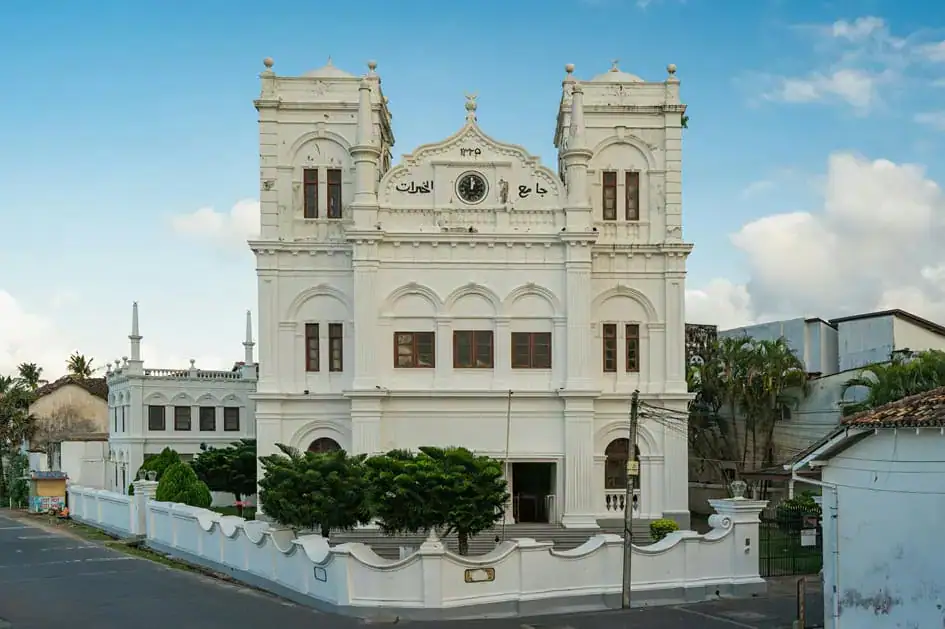
Meeran Jumma Mosque (Photo: Thilina Alagiyawanna, via Pexels)
A Walking Route That Feels Natural
This route follows how most foreign travellers move through Galle Fort while keeping backtracking to a minimum. You will start with the walls, then drop into the streets, then return to the sea edge for sunset.
- Step 1. Start at the Clock Tower near the Main Gate.
- Step 2. Walk the north rampart section from Moon Bastion towards Sun Bastion.
- Step 3. Continue along the western walls towards Triton Bastion and Flagrock Bastion.
- Step 4. Turn inland for Church Street landmarks.
- Step 5. Head south to Point Utrecht Bastion and the lighthouse.
- Step 6. Finish with a meal at Old Dutch Hospital, then return to the ramparts for sunset.
The full fort circuit is several kilometres long, with one popular DIY route covering about 3.5 km and taking 3 to 4 hours, including stops. The rampart circumference is roughly 2.5 km. Use those figures as pacing guides, not strict rules. Your stop time will drive the schedule.
Galle Fort Ramparts: The Main Event
The ramparts form the fort’s strongest identity. This walk gives you the ocean, the skyline, and the bastion network in one sweep. You will see coral stone mixed with granite. UNESCO notes the use of coral in the rampart structure as a salient feature of local adaptation.
Bring water. Wear sun protection. Use shoes with grip since some stone sections feel smooth from centuries of foot traffic.
When you walk the walls, you will see how defence shaped the town. Bastions protrude from the wall line so that cannons can cover adjacent segments. This design reduced blind spots and increased range across the bay.
Bastions
Moon Bastion with Clock Tower
Moon Bastion sits close to the Main Gate and the Clock Tower. Many visitors treat this as the starting point for a wall walk. The position also helps with orientation. You look back towards the gate and forward towards the western walls.
The Clock Tower
The Clock Tower stands near Moon Bastion and marks the fort entrance zone. Travellers often stop for the first photos here because the tower frames the wall line and signals the shift from modern Galle to the historic core. Visitor write-ups often pair the Clock Tower with a first rampart walk segment.
Sun Bastion from the West
Sun Bastion sits along the northern-to-western transition. The view changes here. On calm days, you see long lines of horizon. On rough sea days, spray rises against the rocks below. Use this point for early photos, before the light turns harsh.
Triton Bastion
Triton Bastion links history and daily life. Historic descriptions note a windmill system used for pumping seawater to sprinkle dusty roads. Today, the location works as a viewpoint. Many walkers pause here before continuing towards the stronger sunset section.
Flagrock Bastion
Flagrock Bastion draws crowds for sunset for a clear reason. The viewpoint faces the open sea, and the light drops straight to the horizon. Historic accounts describe Flagrock as a signalling point that warned ships of dangerous rocks, with warnings given by shots fired from nearby locations.
Arrive 30 to 45 minutes before sunset. You will secure a spot on the wall edge and still have time to watch the sky colour shift.
Point Utrecht Bastion
Point Utrecht Bastion anchors the lighthouse end. The bastion once served defence and navigation roles. The lighthouse stands here now, giving you the most iconic fort-edge skyline.
Akersloot Bastion and the Breadfruit Tree area
Akersloot Bastion matters for a living landmark, the breadfruit tree. Some local sources describe this tree as among the earliest breadfruit introductions to Sri Lanka, linked to Dutch introductions, and located at Akersloot Bastion. You do not need an interest in botany to enjoy the stop. The tree gives shade, scale, and a pause point along the wall line.
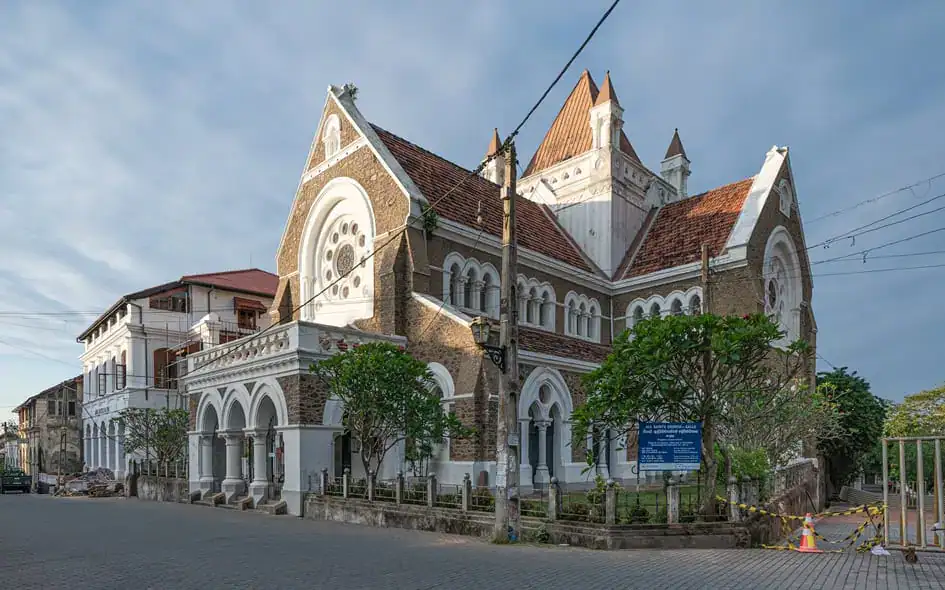
All Saints’ Anglican Church (Photo: A. Savin)
Galle Lighthouse
Galle Lighthouse stands near Point Utrecht Bastion and ranks as the most photographed landmark in the fort. The first lighthouse at Galle dates to the British era in the mid-nineteenth century, with a later lighthouse built in 1939 after a fire destroyed an earlier structure.
Visit twice if time allows.
First visit in the morning for clean white surfaces and a clear sky.
Second visit in late afternoon for warm light and a softer contrast against the sea.
You will see couples, families, and solo travellers lining up for photos on the lane leading to the lighthouse. Move with patience. A quick portrait takes seconds. A crowd clears fast when people cooperate.
A Note on Photos and Respect
Galle Fort functions as a home for residents. Travellers often forget this during photo hunts. Follow the three rules.
- Ask permission before photographing people up close.
- Avoid pointing cameras into open doorways.
- Keep voices low near places of worship.
These choices improve your experience too. You will feel the fort’s quiet power rather than treating the town as a backdrop.
What to Do Inside Galle Fort: Experiences That Fit Most Travellers
A complete visit needs more than a wall walk. You need indoor stops for heat breaks, cultural context, and street life. Use this mix.
- Heritage street walk
- Walk Church Street and nearby lanes with attention to doors, dates, and verandas. Focus on details, not distance.
- Museum hour
- Pick one museum for context, then add a second museum only if interest stays high.
- Food stop in a courtyard
- Choose a shaded spot during midday, then return to the walls for late light.
- Sacred site visit
- Enter one church, one mosque, or the Buddhist temple, depending on opening times and your interests.
- Shopping with limits
- Set a time cap, such as 45 minutes. The fort has many boutiques. Without a cap, shopping eats the day.
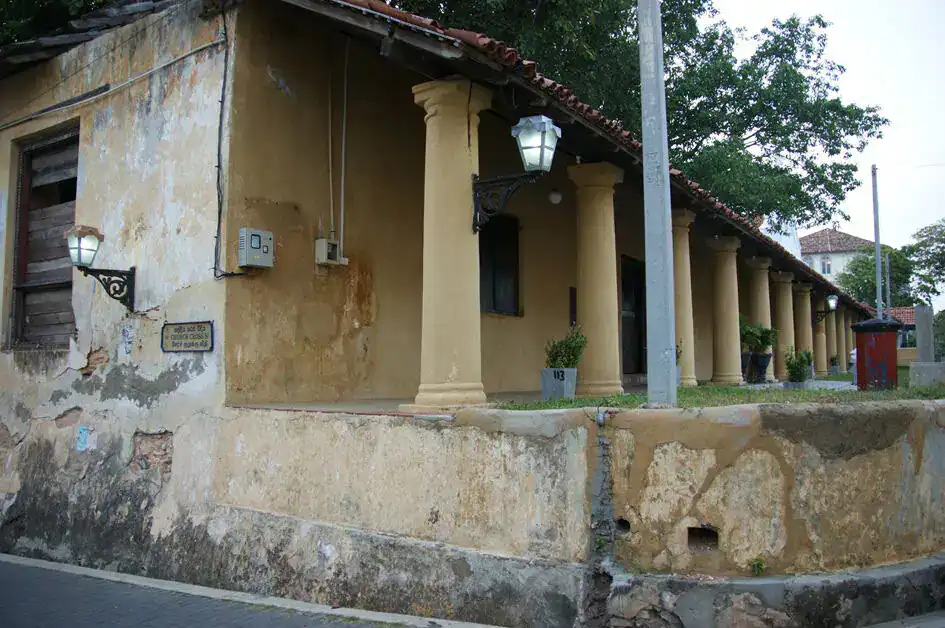
The Post Office – Galle Fort (Photo: Dan Arndt, CC BY-SA 4.0)
Groote Kerk (Dutch Reformed Church)
Groote Kerk, on Church Street, dates to 1755. The church ranks among the oldest Protestant churches still in use in Sri Lanka.
Inside, you will see floor gravestones and memorial plaques. These details carry names, roles, and dates that place Dutch families in the fort’s daily history. The building location also matters. Groote Kerk stands near the fort entrance, making the church an easy early stop.
Practical tips for your visit.
- Dress modestly.
- Keep voices low.
- Avoid blocking aisles during services.
Galle Library
Galle Library sits next to Groote Kerk on Church Street. The establishment was in 1832 and is often referred to as one of the oldest public libraries in Sri Lanka.
Foreign travellers often miss this stop because access is often restricted to members and local use. Even when you do not enter, pause outside. The small-scale, quiet entrance and proximity to two major churches reveal how civic life developed within the fort.
All Saints’ Anglican Church
All Saints’ Church brings the British layer into focus. Sources list the groundbreaking in 1868 and the consecration in 1871, both in the Victorian Gothic Revival style.
Step inside for stained glass and tall interior lines. You will feel a different atmosphere from Groote Kerk. Dutch design favours restraint. Anglican design favours vertical lift and decorative detail.
Meeran Jumma Mosque
Meeran Jumma Mosque reflects the fort’s multi-faith daily life. Sources often date the building to 1904, with a Baroque-influenced façade and Islamic detailing.
- Visit with respect.
- Dress modestly.
- Remove shoes if requested.
- Avoid photography inside unless the staff agree.
The mosque also provides a useful planning benefit. The stop breaks up a long walk between the harbour edge and the inland streets.
Sudharmalaya Temple
Sudharmalaya Temple, also known as Sri Sudharmalaya Viharaya, is located within Galle Fort and serves as the main Buddhist temple within its walls. Sources describe the establishment in 1889.
The temple offers calm. Many visitors step inside during midday when the streets feel hot. You will often hear birds and soft chanting. Spend ten minutes here, and your pace changes for the better.
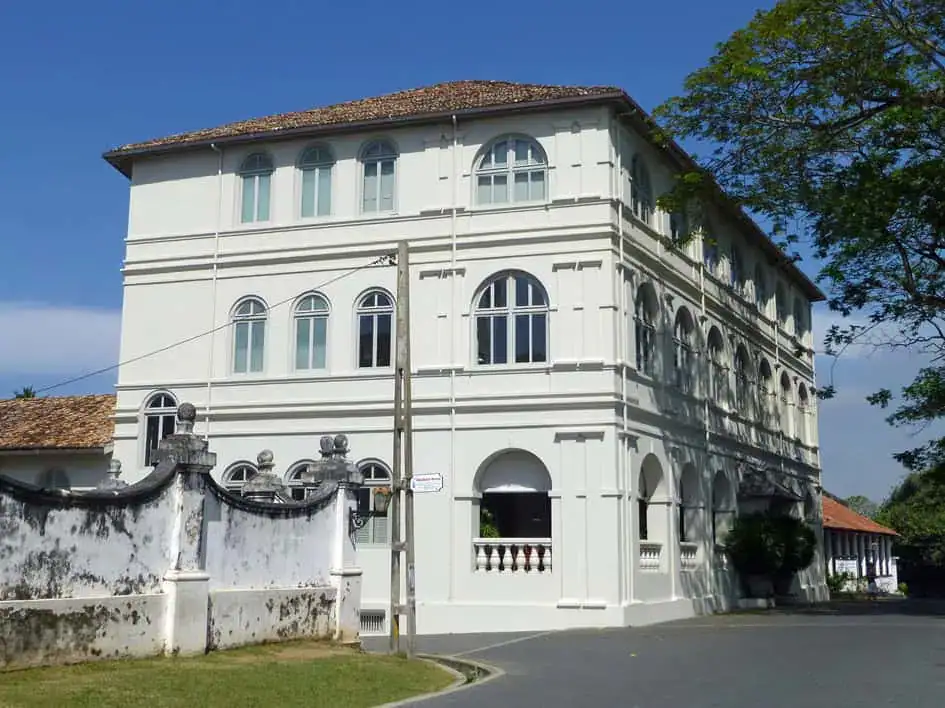
Amangalla Hotel – Galle (Photo: Ji-Elle, CC BY-SA 3.0)
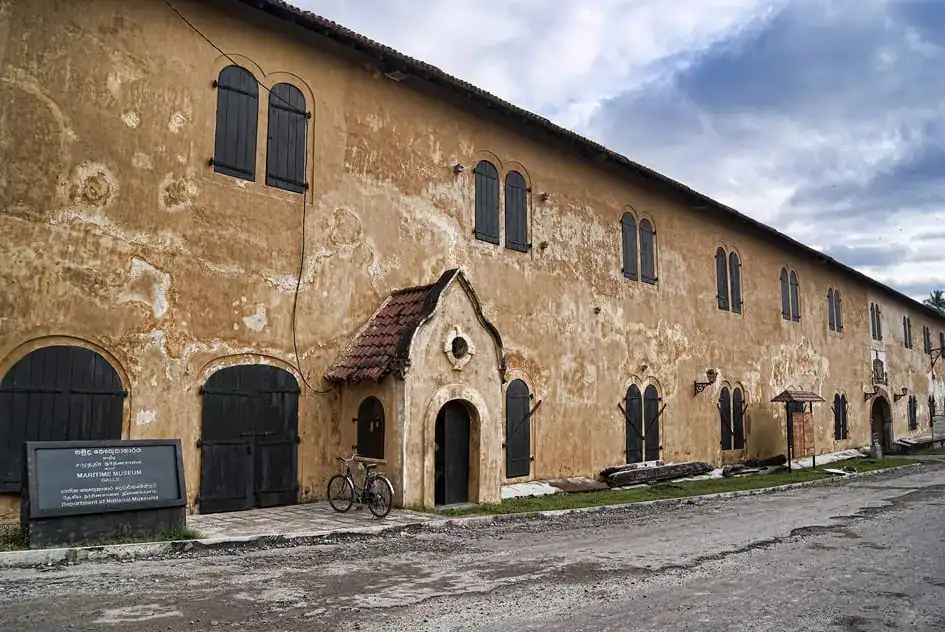
National Maritime Archaeology Museum (Old Dutch Government House Area)
This museum links the fort to the story of the sea trade. Sources describe the museum housed in a Dutch-era warehouse near the Old Gate, built around the seventeenth century to store spices and ship equipment, now used for maritime archaeology exhibits.
Expect displays tied to shipwrecks, maritime trade, and port life. This stop helps foreign travellers understand why Galle mattered long before beach tourism.
Best use of time.
- Give the museum 45 to 75 minutes.
- Pair the visit with a harbour-edge walk afterwards for context.
National Museum of Galle
The National Museum of Galle is housed in a Dutch building within the fort. It displays cultural artefacts related to the region. Visitors often see traditional masks, crafts, and colonial objects, which help connect trade history to local life.
Pair this museum with the church and library area since all sit near Church Street. This cluster reduces walking time and increases depth.
The Privately Owned Historic Mansion Museum
The Historic Mansion Museum offers a different energy from state museums. Sources and visitor reviews describe a private collection showcasing domestic life, antiques, and artefacts housed in a restored colonial building.
You may meet the owner or staff who share personal stories behind objects. This human layer often lasts longer than the wall labels.
Expect a mixed display style. Private museums often feel dense. Move slowly. Focus on a few objects that speak to you, then move on.
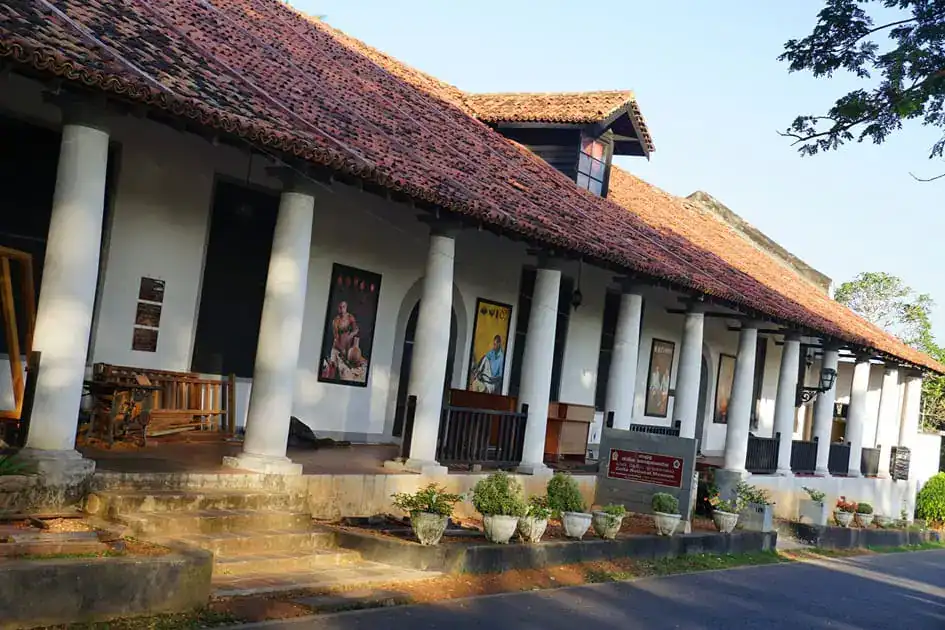
The National Museum – Galle (Photo: Dan Arndt, CC BY-SA 4.0)
Old Dutch Hospital
Old Dutch Hospital, near the ramparts, ranks among the most popular food and shopping zones inside the fort. Sources describe a seventeenth-century Dutch-era origin, built for Dutch East India Company soldiers and officers, later restored and reused for dining and retail.
- Use Old Dutch Hospital as your midday anchor.
- Arrive for lunch.
- Rest in shade.
- Refill water.
- Then return to the walls for late afternoon.
Amangalla
Amangalla offers one of the strongest interior heritage experiences in Galle Fort. Sources describe the property known as the New Oriental Hotel for a long period, starting in the nineteenth century, and later transformed into Amangalla in 2005.
You do not need a hotel booking to appreciate the place. Many heritage hotels welcome guests for dining or afternoon tea. Ask staff about access rules. Dress neatly. Respect quiet spaces.
What to look for.
- High ceilings for tropical airflow.
- Long verandas facing gardens.
- Historic photos and objects tied to steamship travel.
New Orient Hotel
The New Orient Hotel name links to the older identity of Amangalla. Sources note conversion to a hotel in 1865, serving European passengers travelling through Galle Port, later modernised under Aman.
This stop works as a story point. The building shows how Galle shifted from a trade port to a leisure stop for long-distance travellers.

The Famous Lighthouse – Galle Fort (Photo: Diwyanjalee Wanigasekara, CC BY-SA 4.0)
The Galle Fort Hotel
Galle Fort Hotel sits inside a restored seventeenth-century Dutch merchant’s house and received a UNESCO Asia-Pacific Heritage Award of Distinction for conservation work. It matters for travellers who care about adaptive reuse done with care.
Even if you do not stay overnight, walk past the façade on Church Street and note how restoration preserved the street scale.
Clan House
Clan House stands on Church Street and ties directly to shipping and trade. Sources describe construction by John Black and Company, a British mercantile firm established in Galle Fort in 1847, acting as a coal and shipping agency for the Clan Line shipping company.
This building helps you picture the fort during the steamship era. Galle served as a port stop for fuel, supplies, and administration. Clan House points to those logistics.
Galle Fort Post Office
Galle Fort Post Office has a deep history of colonial infrastructure. Sources describe an early post office opening in 1820, later relocation to the current building in 1872, with the building itself tied to Dutch and VOC administrative use in earlier periods.
Foreign travellers often love two small moments here.
- Buying stamps for postcards.
- Taking a photo of the colonial façade details.
Check the status before planning a visit since restoration and structural issues have affected access in recent years.
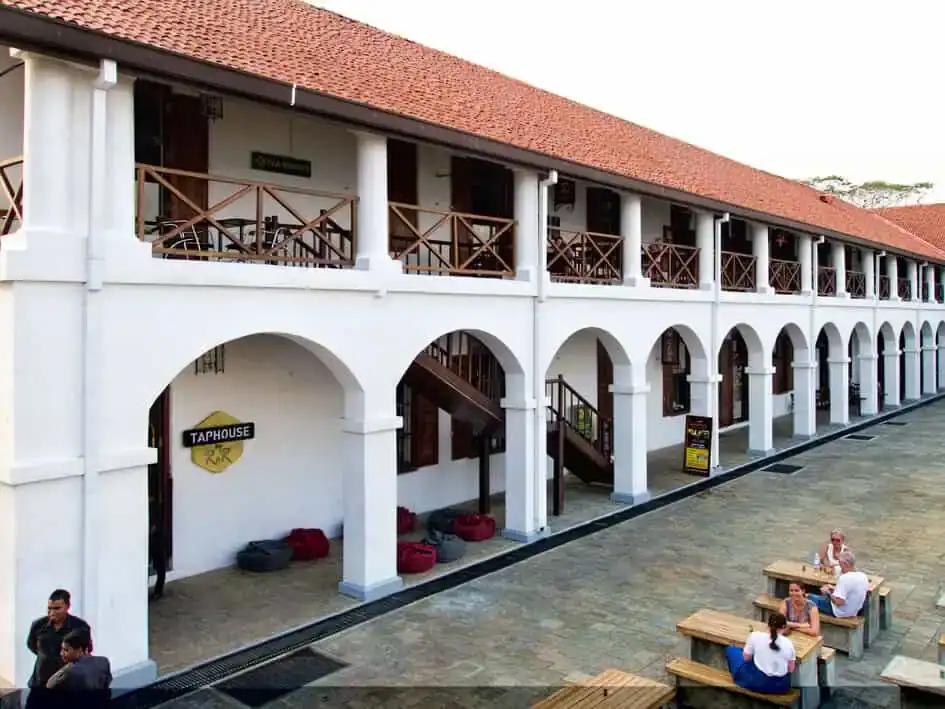
Old Dutch Hospital – Galle (Photo: Dan Lundberg)
The Breadfruit Tree
The breadfruit tree at Akersloot Bastion holds a simple appeal: shade, scale, and a living link to colonial-era plant movement. Sources describe the tree as tied to the Dutch introduction of breadfruit to Sri Lanka and place it at Akersloot Bastion within the fort.
This stop also gives you a break along the ramparts. Sit for five minutes. Watch the sea. Let the pace drop.
Best Things to Do in Galle Fort: Popular Activities, Experiences, and Events
- Sunrise rampart walk
- Start at Moon Bastion. Walk towards the lighthouse. You will avoid heat and crowds.
- Sunset at Flagrock Bastion
- Arrive early. Sit facing the sea. Watch locals gather. This moment anchors many visits.
- Street photography
- Focus on doors, shutters, and shadows. Respect residents.
- Museum pairing
- The National Museum and the Maritime Museum offer trade and culture in one arc.
- Courtyard café break
- Use Old Dutch Hospital or a shaded café on Pedlar Street.
- Boutique browsing
- Set a budget and time cap.
- Heritage hotel visit
- Choose Amangalla or Galle Fort Hotel for the interior atmosphere.
Things to Pair With Galle Fort
Foreign travellers often pair Galle Fort with beaches and day trips along the South Coast. These pairings work because driving times stay short and the contrast feels sharp, stone and sea town in the morning, beach in the afternoon.
National Maritime Archaeology Museum (Photo: Philip Nalangan)
Many guides and travel listings place Unawatuna about 6 km from Galle. Travellers often visit Unawatuna after a fort morning, then return for sunset walls if energy holds.
Jungle Beach
Travel references often place Jungle Beach a short distance beyond Unawatuna and around 7 km from the central Galle areas, depending on the route. Jungle Beach suits snorkelling and a quieter shore feel.
Koggala Area
Koggala sits east of Galle and is often linked to lagoon boat rides and photo stops for stilt fishing. Some travel sources list Koggala at about 21 km from Galle.
A Simple Day Plan That Works for Most Foreign Travellers
Plan A: Half day inside Galle Fort.
- 08:00 Clock Tower and Moon Bastion.
- 08:20 Ramparts towards Sun Bastion, then west walls.
- 09:15 Triton Bastion.
- 10:00 Lighthouse photos at Point Utrecht Bastion.
- 10:45 Maritime Museum.
- 12:00 Lunch at Old Dutch Hospital.
- 13:00 Leave for Unawatuna or rest.
Plan B: Full day inside Galle Fort
- 07:30 Ramparts in cool light.
- 09:00 Lighthouse and coastal lanes.
- 10:00 Groote Kerk.
- 10:45 Galle Library exterior, then All Saints’ Church.
- 11:30 National Museum of Galle.
- 12:30 Lunch at Old Dutch Hospital.
- 14:00 Historic Mansion Museum.
- 15:30 Shopping on Pedlar Street.
- 17:15 Flagrock Bastion for sunset.
- 19:00 Dinner inside the fort.
Plan C: Two-day slow plan with an overnight stay
Day 1: Ramparts, lighthouse, museums, sunset.
Evening: Heritage hotel dining, then a quiet night walk.
Day 2: Religious sites, post office, Clan House, breadfruit tree, then beach time.

Galle Fort at Night (Photo: Thilina Alagiyawanna, via Pexels)
Do Not Miss
- Flagrock Bastion at sunset.
- A full rampart segment, not only a short corner.
- One museum for context, with a maritime focus as the best match for Galle’s port story.
- Groote Kerk on Church Street for Dutch-era traces.
- The lighthouse lane for the fort’s defining photo.
Dos and Don’ts
Dos
- Dress modestly for mosques, temples, and churches.
- Start early for the ramparts.
- Carry water and sun protection.
- Ask before photographing people.
- Use shaded stops during midday.
Don’ts
- Climb unsafe wall edges.
- Block narrow lanes for long photo sessions.
- Treat residential streets like a studio set.
- Leave litter on ramparts.
- Skip museums if history isn’t a big part of your trip.
Sunset – Galle Fort (Photo: Peter Addor, CC BY-SA 4.0)
Final Thoughts: Galle Fort and the Value of a Slow Walk
Galle Fort rewards attention. Stone walls show engineering choices shaped by war and sea. Churches, mosques, and temples show community life inside a colonial grid. Museums explain why this peninsula mattered to global trade. Hotels and cafés show how heritage buildings have taken on new roles without losing their identity.
If you give Galle Fort time, your walk will feel rich and clear. Start with the ramparts. Move inward to Church Street. Pause in a museum. Return to the sea for sunset. You will leave with more than photos. You will leave with a strong sense of place, built from steps on stone and hours inside a living fort.
Map – Galle Fort
Featured image: The Clock Tower – Galle Fort (Photo: Thilina Alagiyawanna, via Pexels)

I am a Sri Lankan medical doctor who spends my free time travelling, exploring new destinations, and documenting the beauty of the island I call home. I have journeyed across almost every corner of Sri Lanka with my wife and daughter — from wildlife parks and misty mountains to ancient cities, deep forests, rugged landscapes, and quiet beaches.
Travel is not just a hobby for me — it’s a way of life. I love nature, enjoy road trips, and find joy in wildlife photography. I also read widely about tourism, travel trends, and destination culture. Through my writing, I aim to help travellers experience Sri Lanka through real stories, meaningful insights, and honest recommendations — the same way I explore it with my own family.