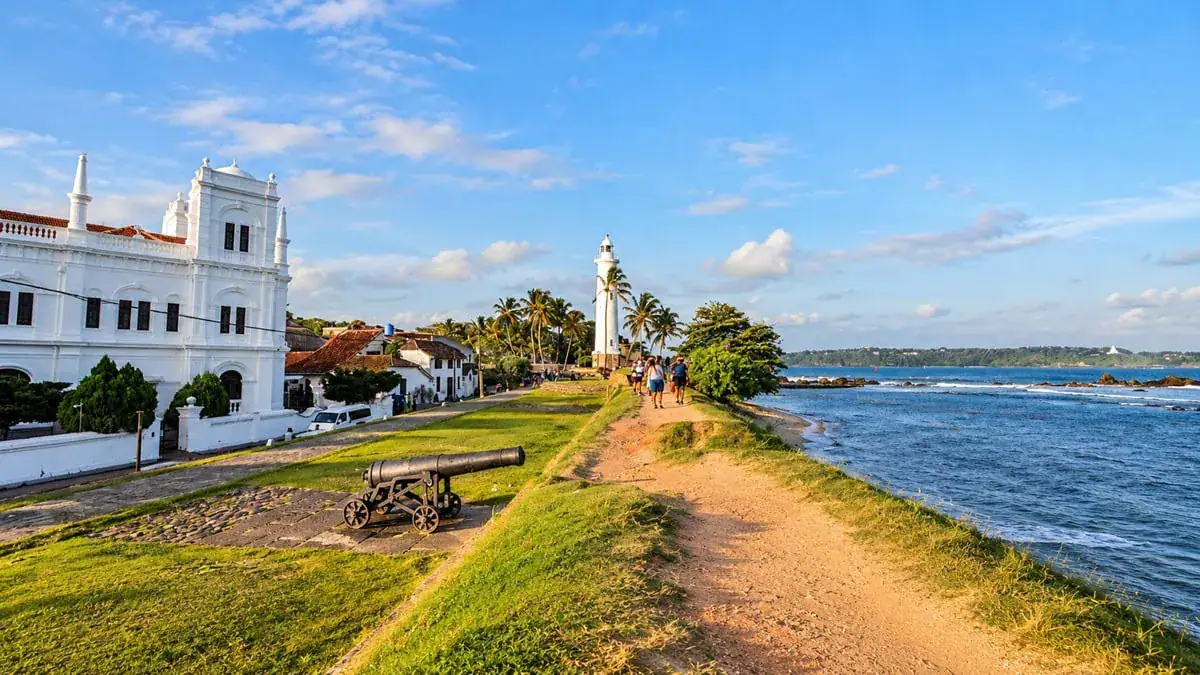

Walk along the ramparts of Galle Fort as the evening light turns the Indian Ocean gold, and you’re standing on ground that has answered to three European flags. Step inside the Dutch church nearby and you’ll find tombstones in a language few locals speak anymore. Take the train into the hills, and you’ll pass tea bushes planted under British rule, before arriving in Nuwara Eliya, a town that still looks like a corner of England in places. These are the Portuguese, Dutch and British heritages in Sri Lanka, and you can still walk through them today.
Three colonial powers ruled parts of the island in turn. Each one built on what came before, and often knocked it down. Together they left forts, churches, railways, tea estates and whole townscapes. This isn’t heritage locked away in glass cases. You can climb it, sleep in it, ride on it and drink a cup of tea in it.
This guide explains what each power left behind, where you can see it and how to fit it into a real Sri Lanka trip. It also keeps one thing in view. Colonial rule is only one part of a much longer Sri Lankan story, and not always a comfortable one.
Portuguese, Dutch and British Heritages in Sri Lanka: The Story in Brief
In Sri Lanka, the three colonial periods rarely sit in neat, separate boxes. Each power captured the buildings of the one before, then changed them and used them for its own purposes. Knowing this from the start makes every fort you visit easier to read.
Portuguese Heritage in Sri Lanka: Where the Story Began
The Portuguese arrived almost by accident. In 1505, a fleet under Dom Lourenço de Almeida was blown off course and landed near Galle. Trade in cinnamon soon followed. By 1518, the Portuguese had built a fort at Colombo. Over the next century they took control of most of the coastal lowlands. However, they never conquered the highland kingdom of Kandy.
Portuguese rule ended in 1658, and very little Portuguese stonework survives. The Dutch and British kept using the same strategic sites and rebuilt them. So at most “Portuguese” sites, you’re really seeing where a place began, buried beneath later walls. The living legacy is easier to find. It shows up in the Roman Catholic communities of the coast, and in Portuguese surnames, words and food influences in everyday life.
Dutch Heritage in Sri Lanka: Forts, Churches and Street Plans
The Dutch East India Company (VOC) moved against the Portuguese in the seventeenth century, drawn by the same cinnamon trade. Galle fell to the Dutch in 1640, and Jaffna and Mannar followed later. Dutch control of the coast lasted until the end of the eighteenth century.
The Portuguese had often built quickly. The Dutch built to last. They left strong stone forts, Dutch Reformed churches, planned street grids and canals for moving cinnamon. Galle is the finest example. Dutch work also survives in Colombo, Negombo, Jaffna, Batticaloa, Matara and Kalpitiya.
British Heritage in Sri Lanka: Railways, Tea and Hill Stations
The British took over the Dutch coastal territories in 1795–96 and ruled until independence in 1948. They ran a very different kind of colonial economy. Instead of focusing on fortified ports, they built inland. They planted coffee and then tea across the central highlands. They built a mountain railway to carry those crops to the coast. They also created hill stations such as Nuwara Eliya and turned Colombo into a major capital.
Much of Sri Lanka’s most popular Hill Country travel today, from train journeys to tea estate visits, goes back to this infrastructure. None of it was built for visitors. It was built to make money.
Galle Fort: Where Three Colonial Powers Meet
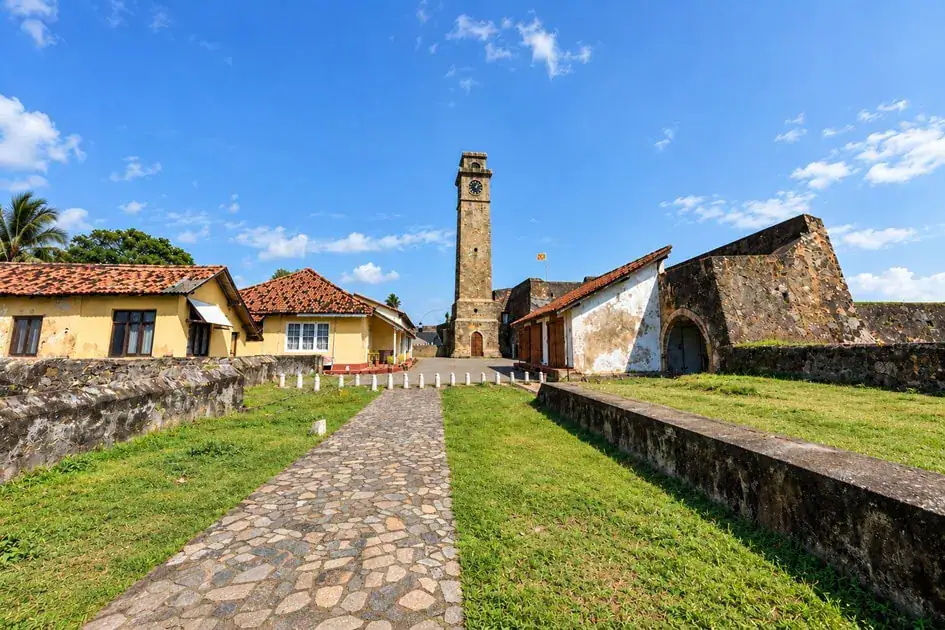
The Clock Tower in Galle Fort (Photo: Nalaka Priyantha)
If you see only one place for colonial heritage in Sri Lanka, make it Galle Fort. Here the Portuguese, Dutch and British periods stop being three separate stories. They sit on top of one another, and you can read them together.
How Galle Changed Hands
The Portuguese fortified Galle in the sixteenth century. They were drawn by its natural harbour and its easily defended headland. Their defences were fairly modest, built from earth and timber.
The Dutch captured Galle in 1640 and rebuilt almost everything. They replaced the Portuguese earthworks with massive granite and coral ramparts. They laid out the street grid that still shapes the old town. They even built an underground drainage system that the tides flushed twice a day, a clever piece of engineering for its time. UNESCO describes Galle as a Portuguese foundation that reached its height under the Dutch in the eighteenth century.
The British took Galle in 1796. They changed little about the walls. Instead, they added civic buildings, a lighthouse and offices, and used the fort as a base while Colombo grew into the island’s main port.
So don’t expect to spot “the Portuguese bit” and “the Dutch bit”. Almost nothing you see today was built by the Portuguese. You’re walking through a Dutch-engineered town, refined by the British, on a site the Portuguese chose.
Walk the Ramparts and Bastions
If you do one thing in Galle Fort, walk the ramparts. It costs nothing, and it’s the best way to understand how the fort works.
The full circuit takes about an hour at an easy pace. The Dutch bastions have names such as Sun, Moon, Star and Aeolus. They were placed so that defenders could fire along the coast and towards the harbour from several angles at once. Walking between them makes this clear in a way no map can.
Late afternoon is the classic time to go. Local families and visitors fill the walls as the sun sinks towards the sea. The golden light on the old coral-stone walls is one of Sri Lanka’s most photographed scenes. For fewer crowds and cooler air, go early in the morning instead.
Groote Kerk (Dutch Reformed Church)
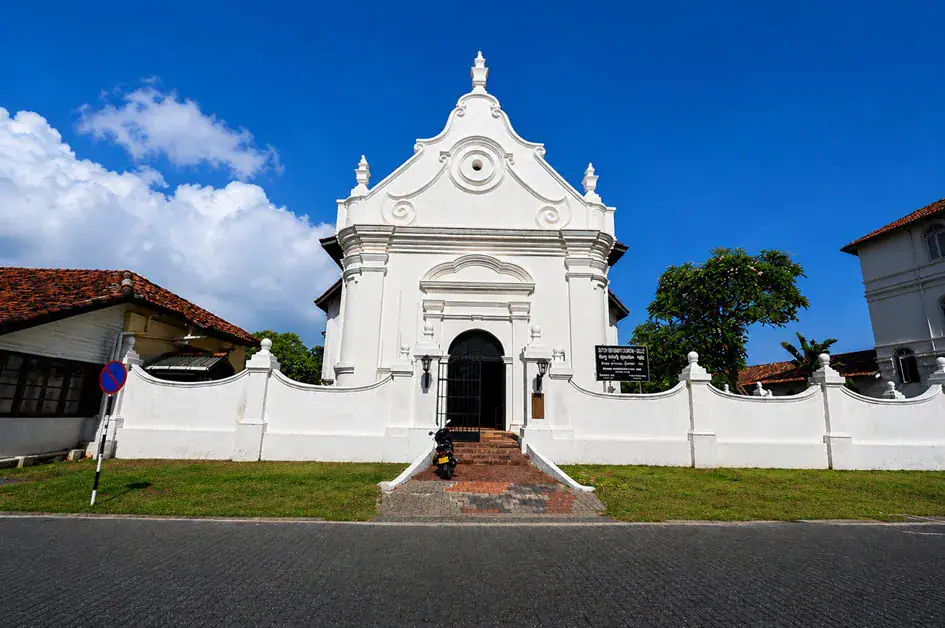
Dutch Reformed Church – Galle Fort (Photo: Nalaka Priyantha)
The Groote Kerk, or Great Church, stands at the highest point inside the walls. It’s among the oldest Protestant churches still in use in Sri Lanka. The present building dates from 1755 and stands on the site of an earlier Portuguese Capuchin convent.
Its floor is paved with gravestones brought from Galle’s old Dutch cemetery. Some inscriptions are still readable. They remember Dutch officials, soldiers and their families who died far from home. Look for the heavy ironwood roof timbers, the hexagonal wooden pulpit and the coats of arms on the walls. This is still an active church, so check that no service is underway before you go in.
Old Dutch Hospital and National Maritime Museum
The Old Dutch Hospital was built to treat officers and staff of the Dutch East India Company. Today the thick-walled, high-ceilinged building holds restaurants, cafés and shops around a courtyard and shaded verandas. Many visitors treat it simply as a lunch stop. But it’s a real Dutch colonial building, given a new use instead of being pulled down.
Near the old harbour gate, the National Maritime Museum fills a Dutch warehouse dating from 1671. Part of it is built right into the ramparts. Its shipwreck finds, trading-ship models and fishing gear show why Galle mattered so much. It was a working harbour on Indian Ocean trade routes, sending cinnamon, gems and other goods to markets across Asia and Europe.
Architecture Made for the Tropics
As you walk the streets inside the walls, look at the old houses. Many have deep verandas and shaded inner courtyards. These weren’t standard European features. They were added to cope with Sri Lanka’s heat and monsoon rains.
UNESCO sees this mixing as central to Galle’s importance. The site matters not simply because Europeans built there. It matters because European styles met South Asian traditions. Local builders used local materials and local knowledge of the climate to make European designs work in the tropics. It was a shared process, though a deeply unequal one. You’ll see the same idea at colonial buildings across Sri Lanka.
A Living Town, Not an Open-Air Museum
Around ninety acres inside the ramparts make up a real neighbourhood. People are born, live, work and worship here. Some houses have been home to the same Burgher, Sinhalese, Tamil or Moor families for decades. Burghers are Sri Lankans of mixed European and local descent. Many old buildings now hold guesthouses, cafés and small shops, most of them run by Sri Lankans.
Galle Fort has been a UNESCO World Heritage Site since 1988. The World Heritage Committee still reviews conservation and development pressure here. So treat the fort as you would any neighbourhood where people live.
Colombo: Dutch and British Heritage in the Modern Capital
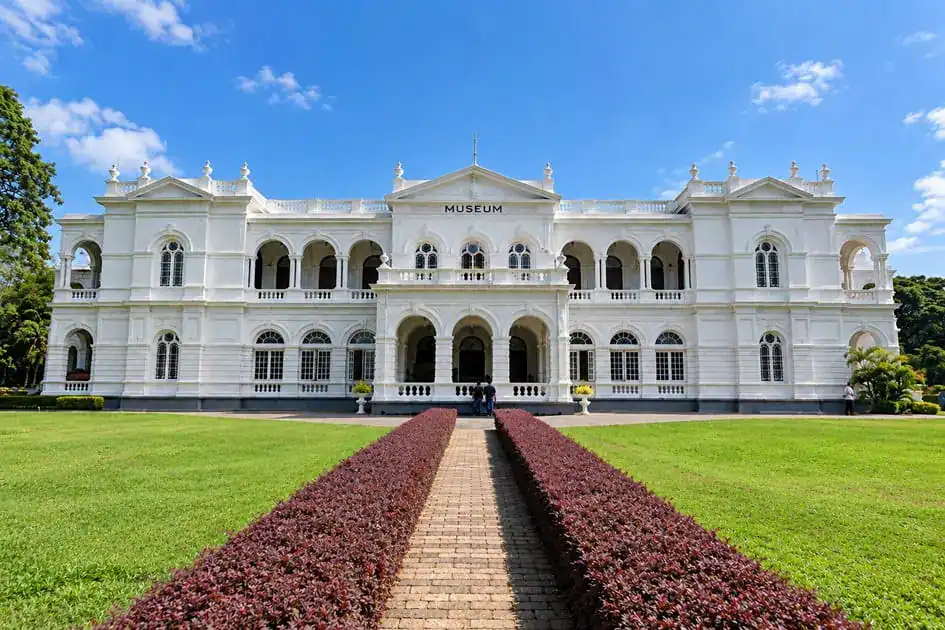
The National Museum in Colombo (Photo: Nalaka Priyantha)
At first sight, Colombo doesn’t look like a heritage city. Glass towers, heavy traffic and a fast-changing skyline dominate the view. But in the older districts of Fort and Pettah, real pieces of Dutch and British Colombo survive. Almost none belong to a single colonial period. Most were added to or reused by whichever power ran the city next.
Dutch Colombo: Wolvendaal Church and the Dutch Museum
Wolvendaal Church, in the busy Pettah district, is the city’s finest Dutch building. It was completed in 1757 after about eight years of work. The cross-shaped church was built to seat up to a thousand people, and it still holds services today. Several Dutch governors are buried here, including the last governor of Dutch Ceylon. Its gravestones record Dutch, Burgher, Sinhalese, Tamil and English names. Together they show how mixed colonial Colombo really was. Unlike Galle’s quiet church, Wolvendaal stands firm amid the noise of Pettah’s markets.
Nearby, the Dutch Museum (also called the Dutch Period Museum) fills a former Dutch residence. Its period furniture and household objects give a more personal sense of daily life in Dutch Colombo.
British Colombo: Fort, Galle Face and the Old Parliament
Under the British, Colombo gradually replaced Galle as the island’s main administrative and commercial centre. Much of the city’s shape comes from this time. Colombo Fort, the old commercial core, still holds many colonial banks and trading houses. Galle Face, the long seafront south of the Fort, was laid out as a public space. It’s still one of Colombo’s favourite places for an evening stroll. The Old Parliament Building, completed in 1930, faces the harbour in grand neoclassical style. It housed the country’s parliament until 1983, when parliament moved to Sri Jayawardenepura Kotte.
Colombo National Museum
The National Museum was founded in 1877 by Governor Sir William Henry Gregory, in an impressive Italianate building. Its collections cover the whole of Sri Lankan history, including the regalia of the Kandyan kings.
It’s a useful visit for another reason. Colonial rule lasted about four and a half centuries. Sri Lanka’s story goes back more than two thousand years before that. The museum puts the colonial period back in its place, as one chapter of a much longer history.
Negombo: Portuguese Catholic Heritage and the Dutch Canal

Dutch Canal – Negombo (Photo: A.Savin)
Negombo sits close to Sri Lanka’s main international airport. That makes it an easy place for a first or last night. It also offers a gentle introduction to the island’s colonial layers.
A Catholic Fishing Town
The Portuguese brought Catholicism to this coast in the sixteenth century, and it never left. Negombo has one of the highest numbers of Roman Catholic churches in Sri Lanka. Church processions and feast days remain part of life in this fishing town.
Not every church here dates from Portuguese times, though. Many were built or rebuilt under Dutch or British rule, and some are much newer. What’s truly Portuguese about Negombo is the faith itself, part of local life for five centuries.
The Dutch Canal
The waterway known as the Dutch Canal has a more mixed past than its name suggests. Its roots go back to the fifteenth century, when King Veera Parakramabahu VIII of Kotte had channels dug to carry goods to the ports. The Dutch later expanded the system to move cinnamon and control flooding, giving it its popular name. The British actually dug the 14.5-kilometre stretch called the Hamilton Canal between 1802 and 1804.
Today, a boat trip along the canal is a peaceful way to see fishing boats, small villages and the birdlife of the Muthurajawela wetlands. It makes a relaxing break from forts and churches.
Nuwara Eliya: Sri Lanka’s “Little England”
If Galle is where Portuguese and Dutch heritage overlap, Nuwara Eliya is where British heritage in Sri Lanka is at its most concentrated, and its most eccentric. The town sits more than 1,800 metres above sea level in the central highlands. It exists because the British wanted a cool, English-feeling escape from the heat of the coast.
The story starts in the 1820s. An army surgeon, John Davy, reported on the area’s unusually cool climate. Governor Edward Barnes took an interest, had a road built and, in 1828, built a large mansion there called Barnes Hall. Governors, officials and planters soon followed. They built holiday houses, churches, clubs and civic buildings in a deliberately English style, in a climate cool enough for log fires. The result is a town widely nicknamed “Little England”, with red-brick Tudor-style buildings, rose gardens, a racecourse and a golf course.
Nuwara Eliya Post Office
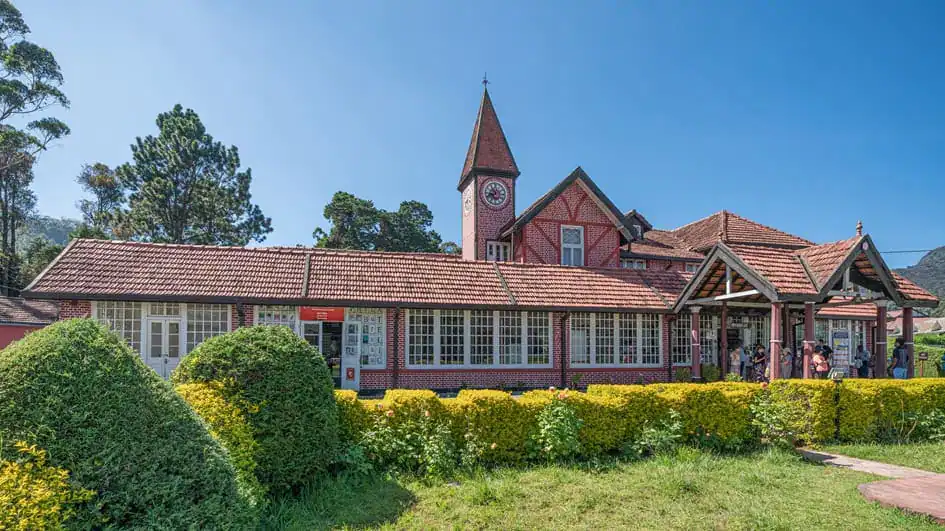
Nuwara Eliya Post Office (Photo: A.Savin)
The red-brick Post Office, built in 1894, is one of the most photographed buildings in the Hill Country. Its corner clock tower and steep roof are classic Tudor Revival style. Sri Lanka Post even put it on a stamp in 1990. It’s still a working post office, and sending a postcard from its counter is a popular small ritual.
The Grand Hotel
The Grand Hotel grew out of Barnes Hall, the governor’s 1828 mansion. After Barnes left, the house passed through several owners before becoming a hotel in the early 1890s. Later extensions, including a mock-Tudor third floor in the 1930s, gave it the rambling shape it has today. You don’t need to stay here to enjoy it. Many visitors stop for afternoon tea on the lawns.
The Hill Club
British coffee planters founded the Hill Club in 1876 as a “home away from home”. For decades it was a strictly exclusive gentlemen’s club. Women and Sri Lankans could not become members until 1967. In its early years, even visiting European women had to use a side entrance.
That history matters. The club wasn’t just a charming social institution. It was a clear expression of the racial and gender barriers of colonial society. Today it welcomes overnight guests and diners, and men are still expected to wear a jacket and tie at dinner.
Victoria Park and the Colonial Townscape
Nuwara Eliya is best enjoyed as a whole townscape rather than building by building. Start at Victoria Park, with its lawns, flower beds and shady paths. Around it you’ll find gabled, half-timbered buildings, English-style gardens and a lake used for boating. The golf course, first laid out in 1889 by a Scottish soldier, is one of Sri Lanka’s oldest.
Unlike Galle, the appeal here isn’t military engineering. It’s climate, atmosphere and social history. Give it several unhurried hours, or better still, stay the night.
Sri Lanka’s Tea Country: A British Legacy That Became Sri Lankan
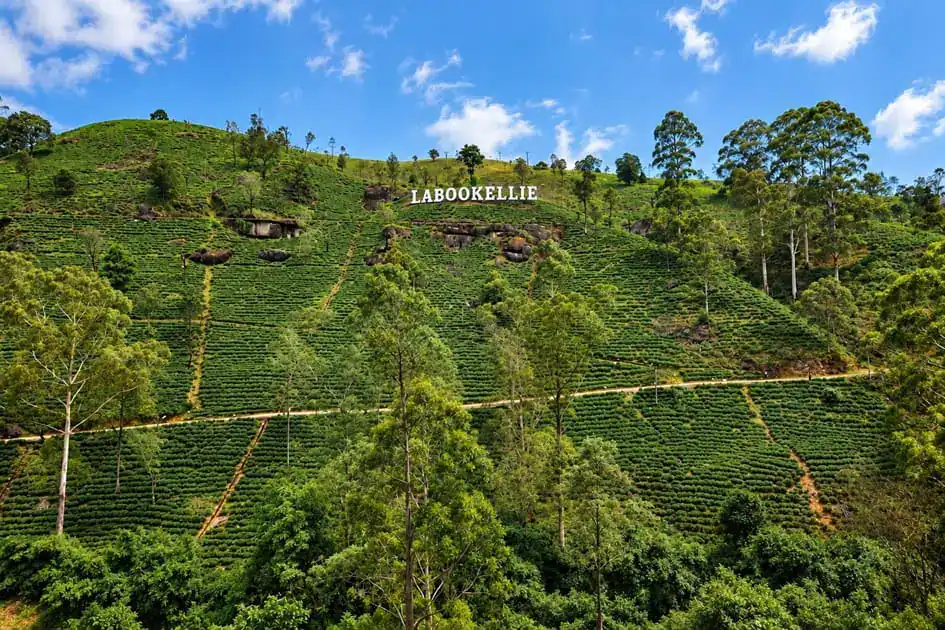
Labookellie Tea Estate – Nuwara Eliya (Photo: Nalaka Priyantha)
Nuwara Eliya shows what British rule looked like in the highlands socially. Tea shows what it looked like economically.
From Coffee to Tea
For much of the nineteenth century, the highlands grew coffee, not tea. Then, in the late 1860s, a fungal disease called coffee leaf rust swept through the plantations. Within two decades, it had all but wiped out the coffee industry.
A young Scotsman, James Taylor, was already experimenting with another crop. In 1867, he planted 19 acres of tea on the Loolecondera estate near Kandy. This is generally seen as the start of the Ceylon tea industry. As coffee collapsed, tea spread quickly across the highlands through the 1870s and 1880s.
The People Who Built the Tea Industry
The tea story isn’t only about British planters. The workers who cleared the land and picked the leaves were mostly Tamil labourers, brought from South India by British recruiters. They worked in harsh conditions for low wages. Many lived in estate “line rooms”, some of which are still in use today.
Their descendants, known as Hill Country Tamils or Indian Tamils, are a distinct community from the Tamils of northern Sri Lanka. They remain central to the industry, and their work is still often poorly paid and insecure.
Over time, tea has become truly Sri Lankan. “Ceylon tea” is known worldwide for its quality. It remains a major export and a key source of rural jobs. In 2025, Sri Lanka’s Tea Cultural Landscape was added to the country’s UNESCO Tentative List, a first step towards possible World Heritage status.
Visiting a Tea Estate or Factory
The best way to understand tea is to see it made. Many estates offer tours covering plucking, withering, rolling, oxidation, drying and grading, usually ending with a tasting. A good guide will explain why high-grown tea from Nuwara Eliya tastes different from tea grown lower down.
Tours vary a lot. Some factories are polished and geared to visitors. Others are working factories with a rougher, more authentic feel but less explanation. Choose the one that suits you.
Haputale, Dambatenne and Lipton’s Seat
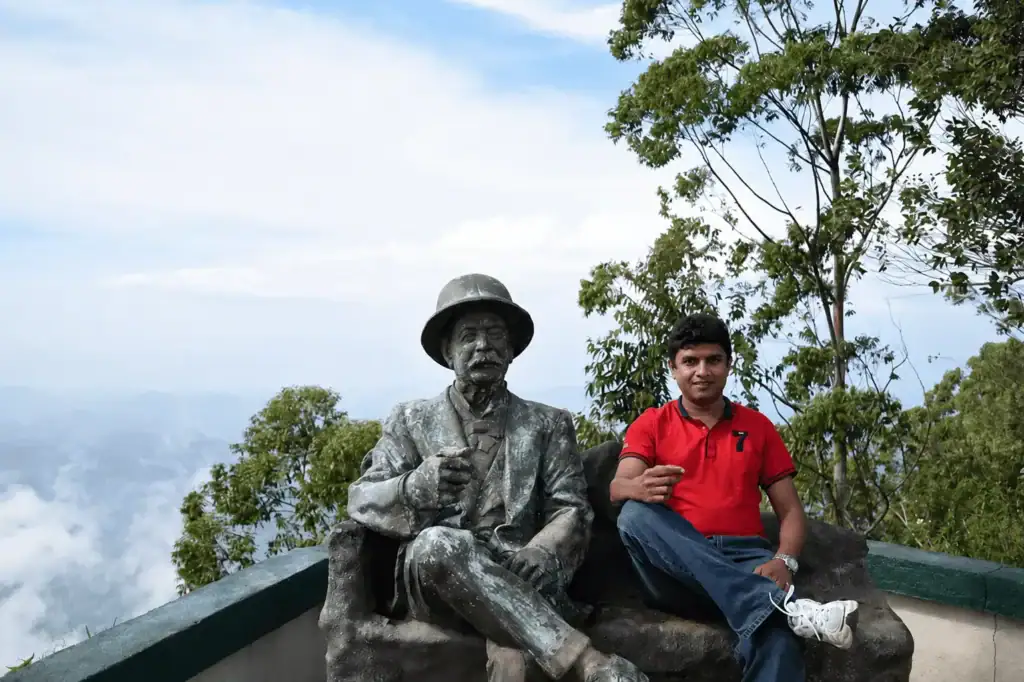
I am sitting with Thomas Lipton (Photo: Nalaka Priyantha)
In 1890, the Scottish tea merchant Sir Thomas Lipton bought the Dambatenne estate near Haputale. The factory he built still operates, and much of its Victorian-era machinery is still in use on tours.
Above the factory, a short but steep drive or walk leads to Lipton’s Seat. Lipton is said to have sat here to survey his tea empire. On a clear morning, before the mist rolls in, the view stretches across ridge after ridge of tea towards the southern plains. Haputale itself is a quieter, working town and a good base for the area.
Nearby, Adisham Bungalow is a Tudor and Jacobean-style house built between 1927 and 1931 by the English planter Sir Thomas Lister Villiers. He modelled it on English country houses, reportedly taking inspiration from Leeds Castle in Kent. Since 1961, it has been a Benedictine monastery, with part of it open to visitors. It makes a short, atmospheric add-on to a Haputale stay.
The Hill Country Railway: From Coffee Line to Iconic Journey
If tea explains the British economy in the highlands, the railway explains how it worked.
Sri Lanka’s first railway line ran from Colombo to Ambepussa. Its first train ran on 27 December 1864, and the line officially opened the following October. It was built to carry coffee from the highlands to the coast. As tea replaced coffee, the railway pushed deeper into the hills. It reached Kandy in 1867, Nawalapitiya in 1874, Nanu Oya in 1885 and Bandarawela in 1894. It finally reached Badulla, the end of the line, in 1924, after sixty years of difficult mountain engineering.
Riding the Line Today
None of this was built for tourists, which is part of its charm. The railway climbs to more than 1,800 metres, winding past tea estates, forested valleys, tunnels and small hill communities. Riding in an ordinary second- or third-class carriage with the doors open is one of Sri Lanka’s great travel experiences. The trains still do the job they were built for, carrying locals as well as visitors.
The main stops shape a natural Hill Country route. Kandy makes a good starting point. Nanu Oya is the station for Nuwara Eliya. Haputale and Bandarawela give access to Dambatenne, Lipton’s Seat and Adisham. Ella, the most developed for visitors, offers walking trails, viewpoints and a relaxed atmosphere. How many nights to spend in each depends on the rest of your route.
Nine Arch Bridge
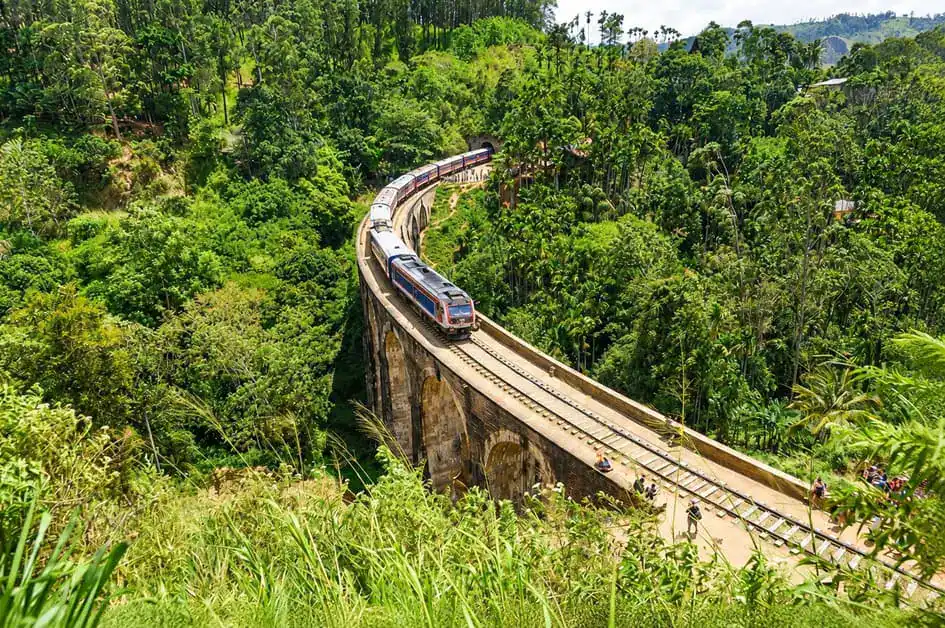
The train passing the Nine Arch Bridge (Photo: Nalaka Priyantha)
Near Ella, between Ella and Demodara stations, stands Sri Lanka’s most photographed piece of railway heritage. The Nine Arch Bridge was completed in the early 1920s. The 91-metre viaduct was built from stone, brick and cement, without structural steel.
Its story comes in different versions. Official records credit the design to Harold Cuthbert Marwood, an engineer with the Ceylon Government Railway. A popular local story credits a Ceylonese builder, P. K. Appuhami. He is said to have solved a foundation problem by filling marshy ground with rock. He is also said to have lain beneath the bridge as the first train crossed, to prove it was safe. Some versions blame a wartime steel shortage for the choice of materials. It’s best to treat these colourful details as legend. Either way, walk to the viewpoint on the Ella side and try to time your visit for a passing train.
We recommend reading about the Kandy to Ella Train ride, one of the best scenic train rides in Sri Lanka.
Jaffna Fort: Colonial Layers in Sri Lanka’s Tamil North
Jaffna Fort tells the same layered story as Galle, but in a very different setting. The Portuguese built the first fort here in the early seventeenth century, as they extended their control over the Tamil kingdom of the peninsula. The Dutch captured it in 1658. They rebuilt and enlarged it on a grand scale, and most of what stands today is their work. The British took over in 1795 and adapted the fort for their own military and administrative use.
Why Add Jaffna to a Heritage Trip?
Jaffna takes more effort to reach, but it isn’t simply Galle further up the map. The landscape is flat, dry and fringed by lagoons, quite unlike the tropical South Coast. The culture is different too. The fort stands in a city with a distinctly Tamil and Hindu heritage, shaped by temples and traditions far older than any European arrival.
That’s the real reason to go. Pair the fort with Jaffna’s temples, markets and Tamil culture, and you’ll add real breadth to your Sri Lanka trip.
Other Forts Worth Adding to Your Route
These forts are interesting, but most aren’t worth a special journey on a first trip. Each one fits best into a route you’re already taking.
Mannar Fort

Mannar Fort (Photo: David Stanley, CC BY 2.0)
The Portuguese built Mannar Fort in the sixteenth century to guard the channel between Sri Lanka and India. The Dutch later rebuilt it, and the British occupied it after them. It stands on Mannar Island, which is linked to the mainland by a causeway. It’s quiet and uncrowded, with good birdlife and a windswept coast. Combine it with a trip to Jaffna and the North.
Batticaloa Fort
The Portuguese built this fort in 1628 on a small island in Batticaloa Lagoon. The Dutch captured it just ten years later, after the King of Kandy asked for their help against the Portuguese. The Dutch rebuilt it in stone. The square, four-bastioned fort has a lagoon on two sides and a canal on the others. Visit if you’re already exploring the East Coast, perhaps on the way to Arugam Bay.
Star Fort, Matara
The Dutch built Star Fort between 1763 and 1765, after the Matara Rebellion exposed weaknesses in the town’s main fort. Its six-pointed star shape let defenders cover every approach with cannon fire. Surrounded by a moat and built from granite and coral, it now holds a small museum on the region’s history. It’s a quick, easy stop along the South Coast.
Kalpitiya Fort
The Dutch completed this stone fort on the Northwest Coast by 1676. Unusually, it was designed to look like a church from a distance, with gable ends to confuse approaching enemies. It now sits inside a Sri Lankan Navy base, so you’ll need permission to visit. It suits travellers already on the Kalpitiya peninsula for kitesurfing, dolphin watching or lagoon trips.
Colonial Legacies Beyond Buildings
Not all of this history survives in stone. Some of it lives on in religion, language and food.
Religion, Language and Place Names
Catholic communities along the West and South Coasts, especially in Negombo, date back to the Portuguese. Dutch Reformed congregations are much smaller but still worship at Galle’s Groote Kerk and Colombo’s Wolvendaal. Both faiths sit alongside Sri Lanka’s larger Buddhist, Hindu and Muslim communities.
Sinhala took in several Portuguese and Dutch words, especially for household life, administration and food. Place names show the clearest traces. Colombo’s Wolvendaal district takes its name from Dutch, while Grand Pass comes from the Portuguese name for an old river crossing. Be wary of longer lists of “colonial” words, though, as many lack solid evidence.
Food
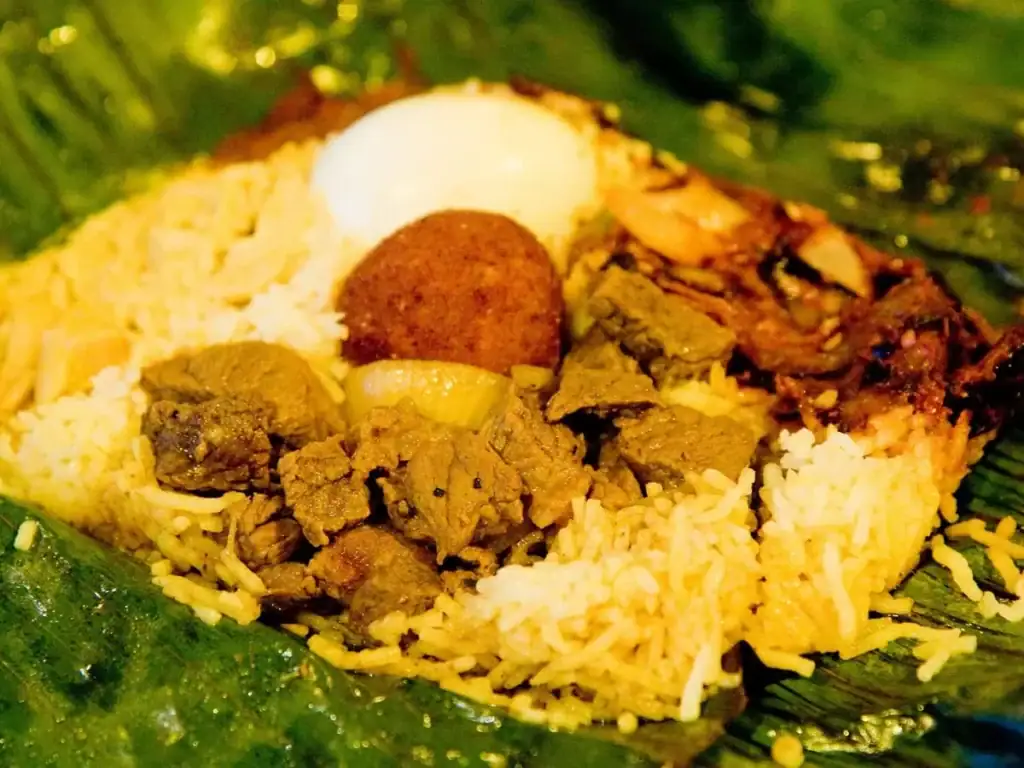
Lamprais (Photo: Garrett Ziegler, CC BY-NC-ND 2.0)
A few well-documented dishes come from the Dutch Burgher community, the descendants of Dutch settlers who married Sri Lankans. Lamprais is spiced rice, curry and side dishes wrapped in a banana leaf and baked. It shows Dutch and Indonesian influence, adapted with South Asian ingredients. Breudher is a rich, buttery fruit cake traditionally baked at Christmas, especially in Colombo. Both are worth seeking out. But most Sri Lankan food developed quite separately from colonial influence.
The Colonial Story Has Another Side
These are fascinating places to visit. In general, they were not built for fascinating reasons.
Centuries of Portuguese, Dutch and British rule brought conquest and long periods of war. European powers took control of land and trade, pushing aside Sri Lankan rulers and communities. They reshaped local government for their own profit. They often treated existing Sri Lankan faiths and traditions as obstacles rather than respecting them.
The tea industry depended on Tamil workers brought from South India under harsh conditions. After independence in 1948, many of their descendants lost their citizenship rights. These rights were restored only slowly, and not fully, over the following decades. For many families in the tea country, this is still part of living memory, not a museum label.
None of this makes these places less worth visiting. Sri Lankans themselves visit and value many of them. But it’s possible to admire the architecture without feeling nostalgic about colonial rule. The Sri Lankan artisans, Tamil labourers, and local builders who made these places deserve as much attention as the European names attached to them.
Above all, these sites now belong to an independent Sri Lanka. For almost eight decades, Sri Lankans have decided what to keep, what to reuse and what to let go.
How to Experience Colonial Heritage in Sri Lanka on a Real Trip
With a week or two, focus on four experiences. Galle Fort shows all three colonial periods together and pairs well with the South Coast. Nuwara Eliya is the best place for British hill-station heritage. The Hill Country railway and tea country let you experience British heritage as a journey. Colombo adds Dutch and British city heritage, and most routes pass through it anyway.
With more time, add sites that fit the way you’re already travelling. Combine Galle with Star Fort on the South Coast. Pair Jaffna with Mannar in the North. Link Nuwara Eliya, the railway and Haputale in the Hill Country without backtracking. Trying to see every fort in one trip usually means long journeys for little extra reward.
For more help, see our complete Sri Lanka travel guide for first-time visitors and find the best travel itineraries for your travel season if you are visiting Sri Lanka for the first time.
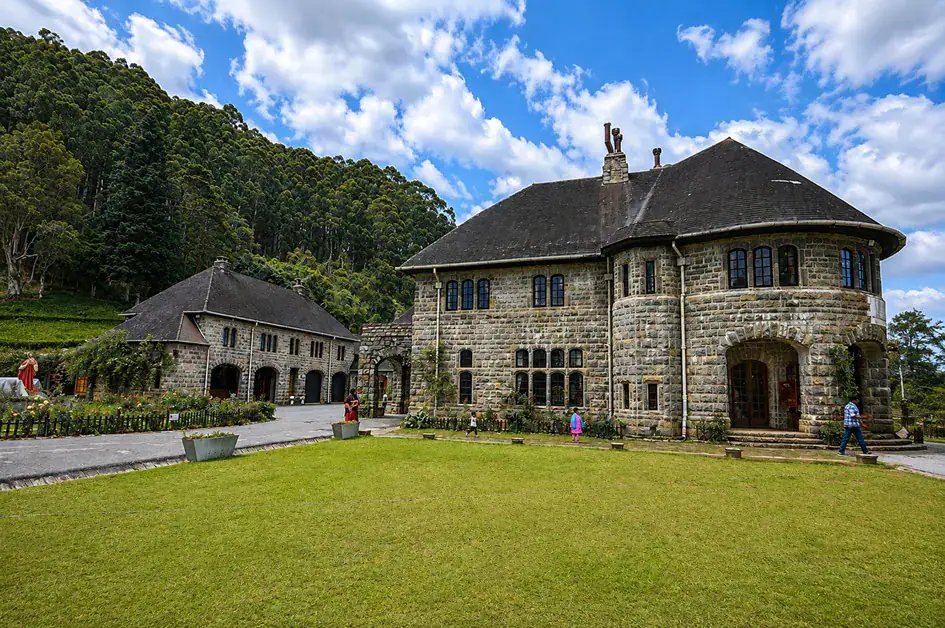
Adisham Bungalow – Haputale (Photo: Nalaka Priyantha)
Which Heritage Places Should First-Time Visitors Prioritise?
| Heritage experience | Main influence | Best for | Easy to combine with |
| Galle Fort | Portuguese + Dutch + British | Architecture, walking, history | South Coast |
| Nuwara Eliya | British | Hill-station architecture | Tea country |
| Hill Country railway | British | Scenery + railway history | Kandy/Ella |
| Haputale/Dambatenne | British | Tea heritage | Ella/Hill Country |
| Colombo | Dutch + British | Museums + urban history | Arrival/departure |
| Negombo | Portuguese + Dutch | Churches + coastal heritage | Airport |
| Jaffna Fort | Portuguese + Dutch + British | Northern history | Jaffna |
| Mannar Fort | Portuguese + Dutch + British | Lesser-visited history | Northern route |
Opening hours, entry rules and access can change, so check current details close to your travel dates.
Responsible Heritage Travel: How to Visit With Respect
- Respect places of worship. Churches such as the Groote Kerk, Wolvendaal and those in Negombo still hold services. Check before entering, and keep quiet if a service is underway.
- Dress modestly at religious sites. Cover your shoulders and knees in churches, temples, kovils, and mosques.
- Ask before taking photos. Some churches and museums restrict or charge for photography. Ask before photographing people at prayer, and don’t photograph private homes and courtyards in Galle Fort without permission.
- Don’t climb on fragile structures. Old ramparts and facades are more easily damaged than they look.
- Pay entry fees. Official tickets help fund conservation.
Conclusion: Three Colonial Periods, One Sri Lankan Journey
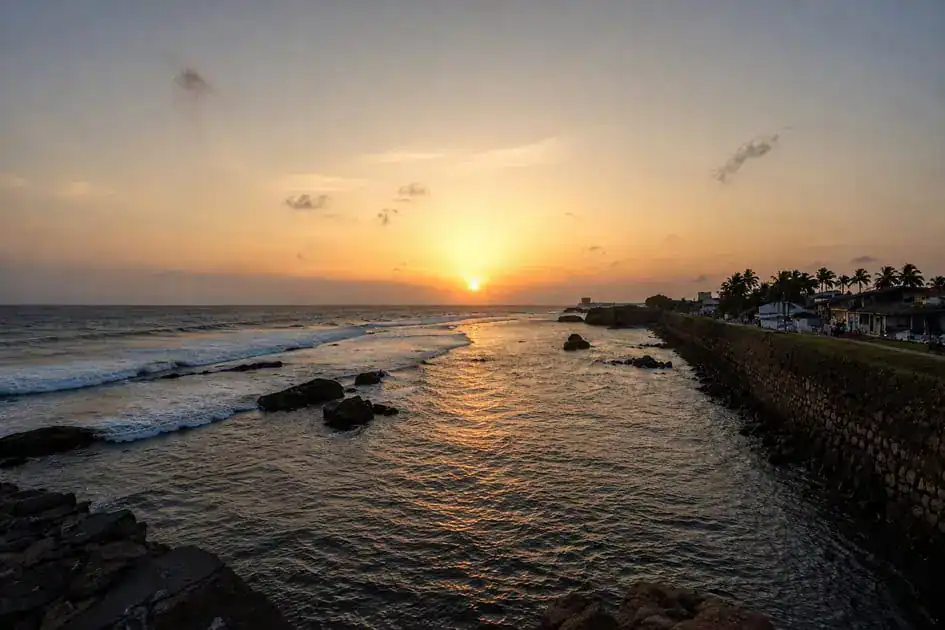
Sunset from Galle Fort (Photo: Nalaka Priyantha)
The Portuguese, Dutch and British heritages in Sri Lanka each feel different. The Portuguese layer is the oldest and least intact. It lives on in the sites later powers built on, in coastal Catholic communities and in everyday language. The Dutch layer is the most complete, seen in forts, churches and whole historic towns, with Galle the finest. The British layer is less about defence and more about a working landscape of railways, tea estates, and hill stations.
But these periods overlap far more than they sit apart. Understanding those layers, rather than sorting every building into a neat box, is what makes exploring heritages in Sri Lanka so rewarding.
You don’t need a specialist trip either. A rampart walk in Galle fits easily around beach days. A train ride and a night in Nuwara Eliya sit well alongside a safari or Sigiriya.
Which layer of Sri Lanka’s past would you most like to explore: the fortified coast, the historic cities or the tea-covered highlands?
FAQ: Portuguese, Dutch and British Heritage in Sri Lanka
What colonial heritage can you see in Sri Lanka?
You can see Portuguese-founded coastal sites, Dutch forts, churches and canals, and British railways, tea estates and hill stations. Galle Fort is the best single place to see all three together.
Where is the best Dutch heritage in Sri Lanka?
Galle Fort. Its ramparts, street grid, Groote Kerk, Old Dutch Hospital and Maritime Museum give the most complete picture. Colombo’s Wolvendaal Church and smaller forts at Batticaloa, Matara and Kalpitiya add more.
Where can you see Portuguese heritage in Sri Lanka?
Few Portuguese buildings survive, because later powers rebuilt most of them. Look for the Portuguese foundations beneath the forts at Galle, Jaffna and Mannar, and for the Catholic culture of Negombo.
Where can you experience British heritage in Sri Lanka?
Mainly in the Hill Country: Nuwara Eliya, the mountain railway, and the tea estates around Haputale and Dambatenne. Colombo’s Fort district and the Old Parliament Building also reflect British rule.
Is Galle Fort Portuguese or Dutch?
Both, and British too. The Portuguese founded it, the Dutch rebuilt it after 1640, and the British added buildings after 1796. It became a UNESCO World Heritage Site in 1988, recognised as the best-preserved fortified city built by Europeans in South and Southeast Asia.
Which colonial heritage sites suit a first trip to Sri Lanka?
Galle, Nuwara Eliya with a Hill Country train ride and tea country, and Colombo or Negombo. All fit easily alongside Sri Lanka’s popular beaches, nature & wildlife, and ancient sites.
Sources and References:
- UNESCO World Heritage Centre — Old Town of Galle and its Fortifications. Authoritative reference for Galle Fort’s Portuguese origins, Dutch development, colonial architecture, fortifications, UNESCO status and the interaction between European and South Asian architectural traditions.
- UNESCO World Heritage Centre — Sri Lanka’s Tea Cultural Landscape. Useful for the development of the Hill Country tea landscape under British colonial rule, plantation infrastructure, railway heritage, South Indian labour, Nuwara Eliya, Dambatenne, Haputale and related heritage sites. Importantly, this is currently on Sri Lanka’s Tentative List, not yet a World Heritage Site.
- Sri Lanka Railways — History of Railways in Sri Lanka. Official source for the introduction of rail in 1864, its original role transporting coffee from the Hill Country to Colombo, and its later expansion alongside the tea industry.
- Sri Lanka Tea Board — History of Ceylon Tea. Official industry source for the decline of coffee, James Taylor’s experiments at Loolecondera and the emergence of Ceylon’s commercial tea industry.
- Janatha Estates Development Board — Loolecondera: The Birthplace of Ceylon Tea. Useful government-sector reference for James Taylor, Loolecondera Estate and the first commercial tea cultivation in 1867.
- Department of National Museums, Sri Lanka. Official reference for the Colombo National Museum, Dutch Museum of Colombo, Galle National Museum and Galle Maritime Museum. It also confirms the Colombo National Museum’s establishment in 1877 under Governor Sir William Henry Gregory.
- Sri Lanka Tourism — Museums. Supporting official tourism reference for the Colombo National Museum, Galle National Museum and Dutch Museum, including their historical background and collections.
- Ceylon Tea Museum — Timeline of the History of Ceylon Tea. Supporting reference for the development of Sri Lanka’s tea industry, including the 1867 Loolecondera planting, early tea manufacture and exports.
Featured image: Galle Fort (Photo: Nalaka Priyantha)

I am a Sri Lankan medical doctor who spends my free time travelling, exploring new destinations, and documenting the beauty of the island I call home. I have journeyed across almost every corner of Sri Lanka with my wife and daughter — from wildlife parks and misty mountains to ancient cities, deep forests, rugged landscapes, and quiet beaches.
Travel is not just a hobby for me — it’s a way of life. I love nature, enjoy road trips, and find joy in wildlife photography. I also read widely about tourism, travel trends, and destination culture. Through my writing, I aim to help travellers experience Sri Lanka through real stories, meaningful insights, and honest recommendations — the same way I explore it with my own family.